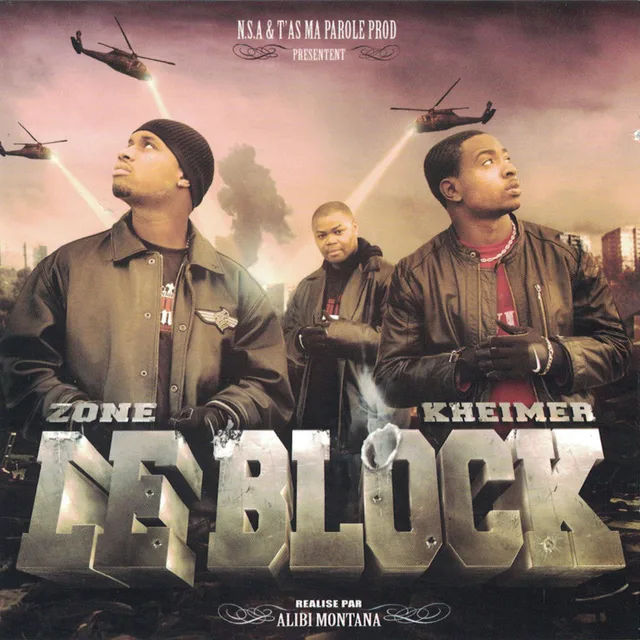
Alibi Montana - Le Block
Alibi Montana's studio album Le Block is an architectural manifesto where absolute coherence triumphs over vocal variety. Released on September 5, 2006, on the label 2Good, this record stands out for its rigorous structure: all fifteen tracks comprising this 58-minute and three-second album are credited with one or more featured artists. Between T'as ma parole (1999) and Crise des banlieues (2006), Alibi Montana builds here a work where every track is the result of a collaboration, transforming the tracklist into a true manifesto of collective consistency.
Collective Opening: Zone and Kheimer on Track 1
The record immediately anchors itself in this logic from the project's introduction. The first track, Intro, sees Alibi Montana share the mic with Zone and Kheimer, thus setting the frame for a closed universe before the narrative even begins. This simultaneous presence of the two figures on track 1 is not an accident but the keystone of the record's sonic architecture. The collaboration continues without interruption on the second track, Le block, where the same voices structure the eponymous song that gives its name to the album. On this third step, Aucun changement, the constancy of the partners remains intact, confirming that Zone and Kheimer are the guardians of the story from the first minutes of listening.
The Heart of the Project: The Uninterrupted Presence of Key Figures
As the progression moves through the album, the collaborative mechanics reach a particular density on the fourth track. It is here that Le passé te rattrape introduces a third voice into the equation: Seth Gueko joins Zone and Kheimer to compose this song. This addition changes the vocal texture of the record, adding another layer to the structure already established by the core duo. The confirmed presence of these three artists on this track 4 demonstrates that the album does not merely engage in sterile repetition but explores varied sonic configurations while maintaining a solid thread. Far from scattering among a multitude of ephemeral partners, Le Block maintains a strong identity thanks to the permanence of certain names. Zone and Kheimer are present on all fifteen songs without exception, creating an unshakable foundation for the project. However, this consistency does not mean the absence of other major talents in French rap at the time who come to enrich this soundscape. Figures like Sefyu, Ikbal, Adebussy, and Ol Kainry also populate the tracks with a regularity that testifies to the collective dimension of the album. The confirmed presence of Sefyu on Pleine Lune (track 10) illustrates this essential vocal diversity central to the concept of the record, while other guests like Seth Gueko or K-Reen add their specific touch to particular songs. This collaborative architecture allows Alibi Montana to consolidate the relationships previously established with Zone and Kheimer while introducing new partners for a total runtime of 58 min 03 s.
The End of the Cycle: New Beginning - Extended Version
The album closes on a note that seals the project after traversing its entire numbered tracklist. The fifteenth and final track, New Beginning - Extended Version, reunites Zone, Kheimer, and this time K-Reen to close the cycle. This final configuration differs from previous tracks where K-Reen only appeared on track 7 (New Beginning - Radio Edit), showing an evolution in vocal combinations toward the end of the album. The confirmed presence of these artists on this closing track marks the end of a linear journey that began with the intro and was built around absolute coherence throughout the record.
Historical Positioning: Between T'as ma Parole and Crise des Banlieues
In terms of discography, Le Block occupies a unique place in Alibi Montana's career trajectory. Situated chronologically between T'as ma parole (1999) and Crise des banlieues (2006), this album marks a period where the artist collaborates exclusively with featured artists across all fifteen tracks. It thus consolidates relationships established previously, notably with Zone, Kheimer, and Sefyu who were already present as early as 2004 on 1260 jours, while introducing new partners such as Seth Gueko, Ikbal, Adebussy, and Ol Kainry. This work stands out for its clear narrative structure: an opening collective piece, thematic tracks at the heart of the project, and a closing track that seals the cycle.
Technical Details
- Release Date: September 5, 2006 - Record Label: 2Good - Tracks: 15 (58 min 03 s) - Opening / Closing: Intro / Nouveau départ - Extended version - Featured Artists: Zone, Kheimer, Seth Gueko, K-Reen, Ikbal, Sefyu, Adebussy, Ol Kainry - Previous Album: T'as ma parole (1999)
🎬 The album's music videos
14 clips · continuous playback
Tracks
🔥 The tracks that are blowing up
Hip-Hop/R&B ranking · week of 12/10/2026
- 1Solar Eclipse— Drake & Don Toliver
- 2Quebec— Drake
- 3I Just Might— Bruno Mars
- 4Cold Shoulder— Drake, Don Toliver & Yebba
- 5Janice STFU— Drake
- 6Dead Fresh— Lil Baby
- 7Classic— Drake
- 8What You Need— Tems
- 9Cinderella— Mac Miller Featuring Ty Dolla $ign
- 10So Good— Jhene Aiko Featuring Kendrick Lamar