
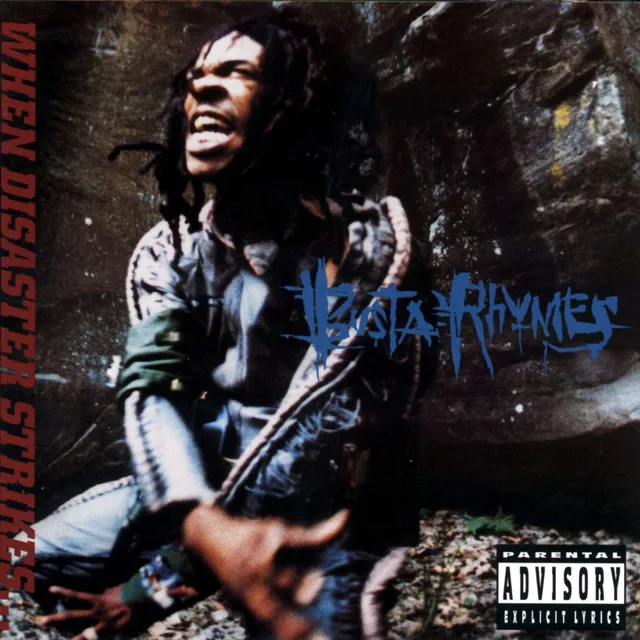
Busta Rhymes - When Disaster Strikes…
When the screen lights up in 1997, the tension is palpable. This isn't just an album; it's a major statement of intent for American hip-hop, orchestrated by Busta Rhymes on the Elektra label. Following The Coming, this second studio effort doesn't seek to repeat last year's success but instead anchors itself in popular culture through a massive and eclectic strategy of collaboration.
An army of allies: Diddy, Mase, and Erykah Badu on key tracks
The power of When Disaster Strikes... lies in its ability to transform personal flow into a collective platform. The album features six tracks with featuring, an audacious strategy for the era aimed at expanding the listener base without diluting the artist's identity. At the heart of this army is Sean Combs (Diddy), credited as primary producer on The Body Rock, where he shares the mic with Mase and Rampage. This presence strengthens the connection to Bad Boy Records, adding a specific commercial and sonic dimension to the track while maintaining the aggressive energy characteristic of the project. The diversity of engaged voices is equally striking. On One, Erykah Badu joins the mix, bringing an R&B/Soul touch that contrasts with the usual hardness of Busta Rhymes' rap. This structural collaboration introduces a new vocal and harmonic texture to the album, expanding its emotional palette without betraying its central theme. Similarly, on There's Not a Problem My Squad Can't Fix, Jamal shares the mic, while We Could Take It Outside sees a real avalanche of talents: Baby Sham, Flipmode Squad, Lord Have Mercy, Rah Digga, Rampage, Serious, and Spliff Star. This massive collaboration creates a dense urban choir effect, where each voice adds nuance to the track's communal message.
The diversity of producers (Ummah, Pete Rock, Q-Tip) serving Busta's flow
Behind these collaborations lies a production with multiple faces, testifying to a desire to touch every vein of hip-hop. The Ummah is credited on So Hardcore, offering a beat that serves as a solid foundation for the raw energy of the track. Easy Mo Bee appears on Things We Be Doin' for Money, Part 1, while Pete Rock and Q-Tip are listed among the main producers for the album, contributing to this varied sonic palette that defines the project. The production credits reveal a notable intergenerational collaboration. J Dilla is present in the list of main producers, adding a unique experimental and rhythmic dimension to the compositions. Sean Combs (Diddy) produces The Body Rock, while Rockwilder handles the track with Erykah Badu. On Things We Be Doin' for Money, Part 2, credits are shared between Clarence Dorsey (co-producer), 8-Off, and featured artists Anthony Hamilton, Rampage, and The Chosen Generation. This mosaic of names ensures that each song possesses a distinct sonic identity, far from uniform production.
Six tracks with featuring: a strategy to anchor the album in pop culture
The collaborative approach is not only aesthetic but also strategic for the reception of the work. By integrating names like Diddy, Mase, or Erykah Badu on key tracks, Busta Rhymes positions When Disaster Strikes... as an event album. The presence of these artists on the record allows access to different audiences: hardcore rap fans via So Hardcore, R&B listeners thanks to Badu's voice on One, and the entire urban spectrum with massive collaborations like that of We Could Take It Outside. This strategy extends equally to tracks where production is shared. On Put Your Hands Where My Eyes Could See, the credits include Epitome (co-producer), Buddah, and Shamello (producers), showing technical complexity in sound creation. The fact that the record counts exactly six tracks with featuring confirms the calculated dimension of this openness to other artists, turning each collaboration into a hook for the public.
Discography Review: A Monument to Resilience and Innovation
Ultimately, When Disaster Strikes... proves to be far more than a logical follow-up to The Coming. It is an affirmation of singular artistic stature that uses collaboration as a tool for amplification rather than dilution. The album confirms Busta Rhymes' role in hip-hop by demonstrating his ability to orchestrate such a vast project without losing its thematic thread: the apocalypse and resilience against chaos. Reception of this album rests on its internal richness: an eclectic production that blends legends like Pete Rock, Q-Tip, and Easy Mo Bee with rising or specific names like The Ummah and J Dilla. Every track, whether solo or collaborative, contributes to building a coherent sonic universe where diversity is a strength. Six tracks featuring others are not merely additions but pillars supporting the overall musical structure, making When Disaster Strikes... a lasting reference in the catalog of 90s American rap.
🎬 The album's music videos
19 clips · continuous playback
Tracks
- 1
- 2
- 3
- 4
- 5
- 6
- 7
- 8
- 9
- 10
- 11
- 12
- 13
- 14
- 15Onefeat. Erykah Badu
- 16
- 17The Body Rockfeat. Diddy, Mase, Puff Daddy, Rampage
- 18
- 19
🔥 The tracks that are blowing up
Hip-Hop/R&B ranking · week of 12/10/2026
- 1Solar Eclipse— Drake & Don Toliver
- 2Quebec— Drake
- 3I Just Might— Bruno Mars
- 4Cold Shoulder— Drake, Don Toliver & Yebba
- 5Janice STFU— Drake
- 6Dead Fresh— Lil Baby
- 7Classic— Drake
- 8What You Need— Tems
- 9Cinderella— Mac Miller Featuring Ty Dolla $ign
- 10So Good— Jhene Aiko Featuring Kendrick Lamar


