
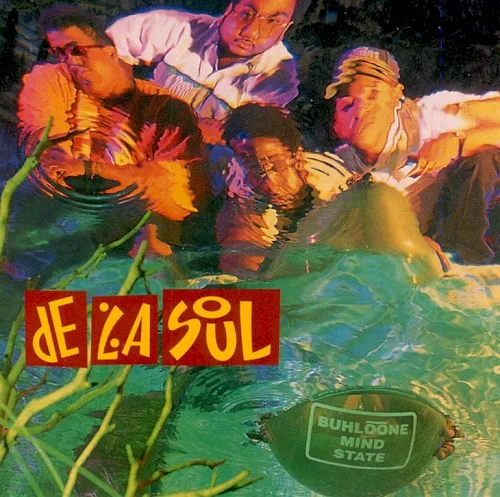
De La Soul - Buhlo͞one Mind State
The air feels thicker, gravity slightly reduced: that's the experience offered by Buhloone Mindstate, whose title plays on the phonetic spelling of the word "balloon." For De La Soul, this third studio album, released by Tommy Boy Records and coming out September 21, 1993, is built as a creative suspension. It follows up De La Soul Is Dead (1991) and precedes the arrival of Stakes Is High (1996), marking a precise point of balance in the trajectory of this New York trio.
Third Act: The Place of Buhloone Mindstate in the Discography
Between the second opus and the next chapter, Buhloone Mindstate occupies a pivotal position. This album of 18 tracks, which opens with "Intro" to close on "Mindstate," represents the final collaboration of the group with Prince Paul as the main producer. This end-of-cycle moment does not present itself as a simple change in technical team but rather as a stylistic closure where the trio's sound reaches a particular maturity before opening up new exploratory paths in the years that follow.
Prince Paul in the Background: The End of a Producer Era
Production-wise, the project is generally credited to Prince Paul, identified as the central creative engine of this work. The facts indicate that it was the last album recorded with him, which gives the project a testamentary dimension within their artistic relationship. This definitive association imprints Buhloone Mindstate with a sonic coherence that sets it apart clearly from the group's previous works, anchoring their identity in a more assertive and less fragmented groove.
Post-disco Groove and Sonic Ambition: The Critics' Verdict
The year-end critical reception of 1993 highlighted an increased focus compared to previous albums. This impression is confirmed by the annual rankings: the album placed at number 8 on Pazz & Jop, the critics' vote from Village Voice, and Robert Christgau, its creator, ranked it fifth on his personal list. In 2005, Chris Rock reaffirmed this value by citing the album as the tenth greatest hip-hop record of all time in a selection published by Rolling Stone.
Between Billboard 200 and Pazz & Jop: A Contrasting Reception
The sonic architecture of Buhloone Mindstate rests on a precise interweaving between the trio's vocals and those of its collaborators, strategically distributed across the tracklist. Beyond "Patti Dooke" and "Sh.Fe.MC's," the album mobilizes other major figures to enrich its rhythmic palette. Shortie No Mass accompanies De La Soul on three distinct tracks: "En Focus," "Ego Trippin (Part Two)," and "In the Woods." This recurrence highlights a particular complicity with this member of the New York underground scene, who brings raw energy contrasting with the fluidity of other passages. On his own terms, Maceo Parker stands out through his presence on two tracks, "I Be Blowin'" and "I Am I Be," where his instrumental interventions underscore the bass lines and synth pads. These casting choices are not random: they reflect a desire to integrate funk and jazz textures that define the group's sonic identity at this specific moment, before the break with Prince Paul. The album structure itself, comprising eighteen tracks, testifies to a narrative ambition rare for a rap record of 1993. Opened by "Intro" and closed by "Mindstate," it frames a progression alternating between sung songs, skits, and collaborations. This organization allows the group to develop varied themes while maintaining global coherence, driven by Prince Paul's production. The fact that this opus is the last recorded with this producer confers each track a value of stylistic synthesis. Guests like Fred Wesley or Pee Wee Ellis, present on "Patti Dooke" and "I Am I Be," do not merely add voices or instruments; they anchor the album in a broader musical heritage, linking alternative hip-hop to the roots of funk and soul. This collaborative density, visible from early tracks like "En Focus" with Dres, positions Buhloone Mindstate not only as a key step in La Soul's discography but also as a turning point where the group asserts its ability to dialogue with the entire American music scene of the 1990s. This paradox between laudatory critical recognition and measured commercial performance underscores the particular status of La Soul: a group that prioritizes artistic depth and sonic innovation over massification. The album's legacy, confirmed by subsequent retrospectives, far exceeds its initial figures, establishing itself as a lasting reference for anyone studying the evolution of American rap in the 1990s.
Technical Details
- Release Date: September 21, 1993 - Record Label: Tommy Boy - Tracks: 18 - Opening / Closing Track: Intro / Mindstate - Guests: Dres, Shortie No Mass, Fred Wesley, Guru, Maceo Parker, Pee Wee Ellis, Biz Markie, A Tribe Called Quest
🎬 The album's music videos
15 clips · continuous playback
Tracks
- 1
- 2
- 3
- 4
- 5
- 6
- 7
- 8
- 9
- 10
- 11
- 12
- 13
- 14
- 15
🔥 The tracks that are blowing up
Hip-Hop/R&B ranking · week of 12/10/2026
- 1Solar Eclipse— Drake & Don Toliver
- 2Quebec— Drake
- 3I Just Might— Bruno Mars
- 4Cold Shoulder— Drake, Don Toliver & Yebba
- 5Janice STFU— Drake
- 6Dead Fresh— Lil Baby
- 7Classic— Drake
- 8What You Need— Tems
- 9Cinderella— Mac Miller Featuring Ty Dolla $ign
- 10So Good— Jhene Aiko Featuring Kendrick Lamar


