
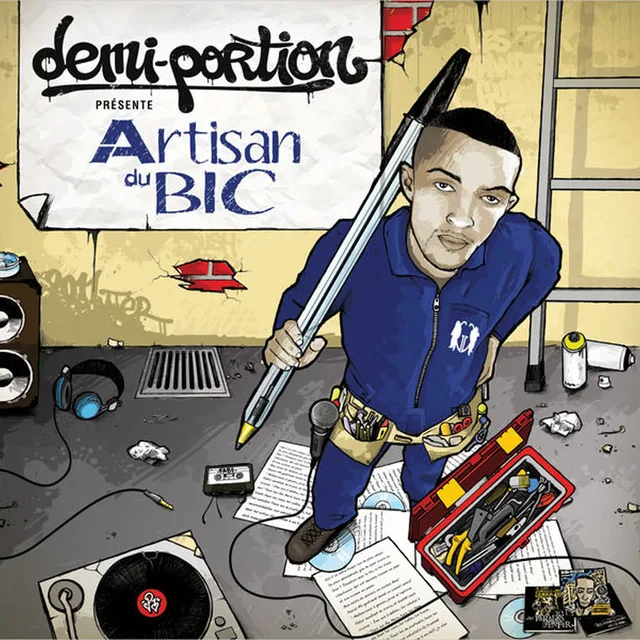
Demi Portion - Artisan du bic
When a rapper titles his album Artisan du Bic, he does not promise the brilliance of a finished object, but rather the thickness of a hand at work. With 15 tracks and a total runtime of 51 minutes and 21 seconds, the work stands out for its radical DIY approach, where production is split among eight different hands, creating a striking contrast with the three tracks left in an auditory shadow zone. That is where all the tension lies in this album: how to maintain narrative cohesion when each track seems assembled by a different worker?
Eight Hands for Fifteen Tracks
The production map of Artisan du Bic draws a heterogeneous mosaic that refuses uniformity. Out of the twelve credited tracks, Sprinter is at the helm for tracks 1 and 9, while Demi Portion handles production on tracks 2, 3, 12, and 15. This arrangement opens the door to an array of external contributors: Filipego on "Le Droit de Tuer", Muzo Prod on "Entre Dedans et Dehors", El Gaouli on tracks 6 and 11, Altruist on "Pour Une Fois", and DJ Saxe on "L'Image". This dispersion is not a flaw of execution but an assumed artistic strategy. By entrusting segments of the album to distinct producers, Demi Portion avoids rhythmic monotony while maintaining a thematic thread centered on origins and daily life. Production acts here as a prism that refracts the same light: that of sincere speech rooted in authenticity, which each beat highlights according to its own texture.
The Three Productive Silences
Among the fifteen tracks, "Interlude" (track 7), "Ma Chaîne Mosaïque" (track 8), and "Besoin d'Aide" (track 10) stand out due to the absence of an explicitly identified producer credit in the verified data. This documentary gap creates a sense of rupture within the sonic continuity of the album. These three tracks function as breaths, transitional zones where the beat gives way to a rougher or more introspective atmosphere. Unlike the other tracks that rely on precise rhythmic construction, these unnamed-producer tracks seem to prioritize ambiance and pure storytelling. They punctuate the listening experience like pauses in a narrative, offering the listener the necessary space to digest Demi Portion's personal words before picking up the musical thread again.
One guest, two distinct roles
Sprinter's presence on this album is unique and doubly marked by his duality. He appears only as a featured vocalist on one track: "Toujours Ensemble" (track 6), produced by El Gaouli. On this track, Sprinter's voice reinforces the dynamic of the duo Les Grandes Gueules, adding vocal chemistry that contrasts with the rest of the album where Demi Portion performs solo in front of the microphone. This distinction is essential: on tracks 1 ("Artisan du Bic") and 9 ("Rêve de Gosse"), Sprinter is not a featured vocalist but rather the producer, signifying a different creative involvement. On "Toujours Ensemble," he brings shared energy, while on his productions, he structures the sonic backdrop. This clear separation between roles avoids any confusion and highlights the specific value of their vocal collaboration on an otherwise very solo album.
The craftsmanship of track 15
If "Artisan du Bic" opens the album with a production signed Sprinter, it is on "Mes Outils" (track 15) that Demi Portion closes his narrative loop by producing his own track. This final symmetry is not incidental: the craftsmanship of the closing mirrors that of the opening, but with a different intention. While the opening track established the rules of the game through an external beat, "Mes Outils" assumes total creative control directly from the artist himself. The decision to self-produce on this last song firmly anchors the album within its own intimate creation process. It reminds us that despite the diversity of producers involved, it is Demi Portion who holds the keys to his expression, transforming his tools into instruments for a final narrative arc.
From Opening to Final Tool
The sonic architecture of Artisan du Bic reads as a back-and-forth between exteriority and interiority. The opening, produced by Sprinter, establishes a shared identity inherited from the duo Les Grandes Gueules. The closing, produced solely by Demi Portion, asserts creative autonomy earned over years in the underground. Between these two extremes, the album navigates between thematic repetitiveness noted by some critics and the textual richness of its personal lyrics on family and origins. This first solo record fits within the continuity of 8 titres et demi (2009) and the EP Sous le choc (2010), thus paving the way for Petit bonhomme (2013). By rejecting showmanship effects and prioritizing disarmingly honest songwriting, Demi Portion signs a record that remains true to its essence: that of a craftsman of words rather than a star of the scene.
Technical Details
- Release Date: October 10, 2011 - Label: Demi-Portion – 2011 - Tracks: 15 (51 min 21 s) - Opening / Closing Track: Artisan du Bic / Mes Outils - Guests: Sprinter - Previous Project: Sous le choc (EP, 2010) - Previous Studio Album: 8 titres et demi (2009)
🎬 The album's music videos
15 clips · continuous playback
Tracks
- 1
- 2
- 3
- 4
- 5
- 6
- 7
- 8
- 9
- 10
- 11
- 12
- 13
- 14
- 15
🔥 The tracks that are blowing up
Hip-Hop/R&B ranking · week of 12/10/2026
- 1Solar Eclipse— Drake & Don Toliver
- 2Quebec— Drake
- 3I Just Might— Bruno Mars
- 4Cold Shoulder— Drake, Don Toliver & Yebba
- 5Janice STFU— Drake
- 6Dead Fresh— Lil Baby
- 7Classic— Drake
- 8What You Need— Tems
- 9Cinderella— Mac Miller Featuring Ty Dolla $ign
- 10So Good— Jhene Aiko Featuring Kendrick Lamar


