
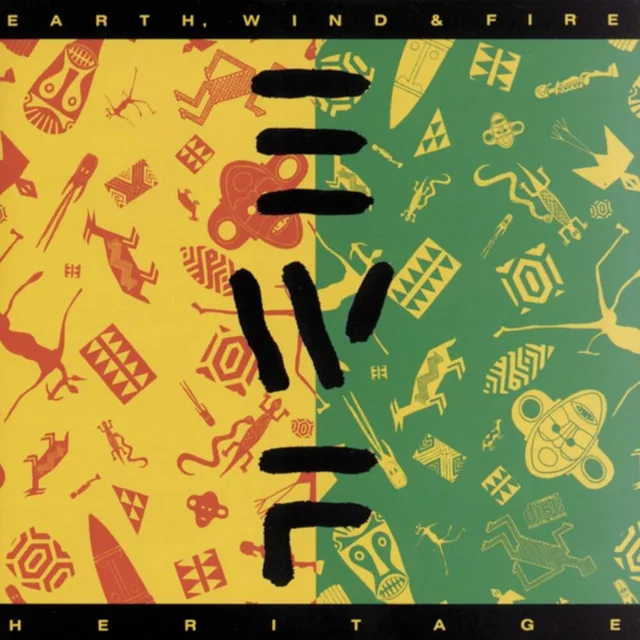
Earth, Wind & Fire - Heritage
When a group that defined the sound of 1970s funk decided to reinvent itself on the threshold of the new millennium, the question was no longer just about whether it could dance, but whether it could survive obsolescence. Heritage, Earth, Wind & Fire's fifteenth studio album released January 29, 1990, via Columbia Records, poses precisely this challenge. With its seventeen tracks totaling 51 minutes and 23 seconds, this opus does not seek to erase the group's legacy but rather transpose it into the emerging rhythmic codes of early 1990s music, between New Jack Swing and rap influences. It is a photograph of an ensemble in full flux, attempting to reconcile its past orchestral grandeur with synthetic modernity imposed by its era.
The Modernization of an Established Sound
Far from abandoning its roots, Earth, Wind & Fire reorganizes its sonic palette to adapt to the trends of the moment. The album incorporates elements of New Jack Swing while retaining the funk and R&B foundations that made the group famous. Maurice White assumes this artistic direction as the main producer, surrounded by a team of co-producers who refine this new sound. Frankie Blue and Les Pierce intervene on several key tracks, while Robert Brookins signs off on the production of specific songs like Good Time or For the Love of You. This diversification of creative hands allows the group to explore varied textures without losing overall coherence.
MC Hammer and The Boys: The Rap Injection
The integration of rap on this album is not incidental; it constitutes a deliberate strategy to reach a new audience. MC Hammer appears on two major tracks: Wanna Be the Man (track 8) and For the Love of You (track 13). His presence anchors these songs in current trends, bringing vocal and rhythmic energy that contrasts with the group's usual ballad softness. On Wanna Be the Man, his flow structures the interaction between funk and rap, creating a direct bridge to emerging hip-hop culture. On For the Love of You, his voice reinforces the crossover aspect of the production, blending Earth, Wind & Fire's vocal power with rap dynamics. The Boys, meanwhile, appear on the eponymous track Heritage (track 3). Their contribution adds a collective and rhythmic dimension to the song, underscoring the group's intention to engage with hip-hop codes without fully dissolving into that genre. These three features confirm the desire to update the group's sound, as noted by critics who observe that the first half of the album is primarily influenced by rap.
Soweto, Bird, Faith: Timeless Pillars
Among these modern forays, the album is structured around short interludes that ground its modernity in deep historical references. Interlude: Soweto opens the record and returns at the close as Soweto - Reprise, creating a strong narrative loop. Other interludes, such as Bird (track 7) and Faith (track 15), represent respectively the jazz tradition and an unshakeable religious alliance. This narrative structure allows the group to claim its historical legitimacy while embracing the present.
The critical reception of a successful but imperfect transition
The press received Heritage with a mix of praise and reservations. John Milward of Rolling Stone saw in it "an album where these survivors of the soul prove that their ancient forces can still sound fresh in the most modern sense of the term." J.D. Considine of the Baltimore Sun noted that the group not only maintained its current form but seems even revitalized by the process of change. However, Mitchell May of the Chicago Tribune criticized the reduction of the brass section to a few perfunctory solos and the muddying of Verdine White's bass lines. He also pointed out the abandonment of the two drummers in favor of a synthesized approach, described as "drum-beats-from-a-can." Lynell George of LA Weekly noted that while the album does not renounce the familiar with its brass and harmonies, it finds the overall structure somewhat heavy-handed.
Columbia's Last Album Before Millennium
The album Heritage fits into a specific discographic trajectory, following the group's well-noted return with Touch The World in 1987 and preceding the release of Millennium in 1993. This chronological positioning underscores the stakes of this production, which must both capitalize on the renewed interest sparked by its predecessor and pave the way for future developments for the collective. The very structure of the album reflects this desire to synthesize past and present, as evidenced by the presence of several thematic interludes such as Interlude: Body Wrap (track 5) or Interlude: Close to Home (track 9), which pace the listening experience without ever breaking the narrative continuity established by the main tracks. In terms of commercial reception, public response was significant internationally, confirming the transatlantic reach of this artistic endeavor. The opus reached number 19 on the Billboard Top R&B Albums chart in the United States while also establishing itself in other strategic territories. It notably secured number 18 on the UK Blues & Soul Top British Soul Albums graph, proof of its resonance among European listeners passionate about soul and funk. This recognition did not remain limited to Europe: Heritage also appeared at number 31 on the Oricon chart in Japan, as well as at number 39 on Finnish and German lists. These figures attest to Earth, Wind & Fire's ability to maintain a loyal and broad audience despite the stylistic upheavals of the 1990s, thus validating their strategy of integrating New Jack Swing and rap influences within a traditional funk framework. Heritage marks a turning point in Earth, Wind & Fire's trajectory. It constitutes the last album of new productions published by the group under the Columbia Records label, ending a collaboration that spanned several decades. After the well-noted return with Touch The World (1987), this opus positions the group within an evolving musical context, before the shift toward Millennium (1993). It is the photograph of a group that managed to remain relevant against fleeting trends while preserving its deep identity. The transition was imperfect, like any artistic mutation, but it testifies to intact creative vitality and the ability to adapt without betraying oneself.
Technical Details
- Release Date: January 29, 1990 - Record Label: Columbia - Tracks: 17 (51 min 23 s) - Opening / Closing: Interlude: Soweto / Soweto - Reprise - Guests: The Boys, MC Hammer - Previous Album: Touch The World (1987)
🎬 The album's music videos
18 clips · continuous playback
Tracks
- 1
- 2
- 3
- 4
- 5
- 6
- 7
- 8
- 9
- 10
- 11
- 12
- 13
- 14
- 15
- 16
- 17
- 18
🔥 The tracks that are blowing up
Hip-Hop/R&B ranking · week of 12/10/2026
- 1Solar Eclipse— Drake & Don Toliver
- 2Quebec— Drake
- 3I Just Might— Bruno Mars
- 4Cold Shoulder— Drake, Don Toliver & Yebba
- 5Janice STFU— Drake
- 6Dead Fresh— Lil Baby
- 7Classic— Drake
- 8What You Need— Tems
- 9Cinderella— Mac Miller Featuring Ty Dolla $ign
- 10So Good— Jhene Aiko Featuring Kendrick Lamar


