
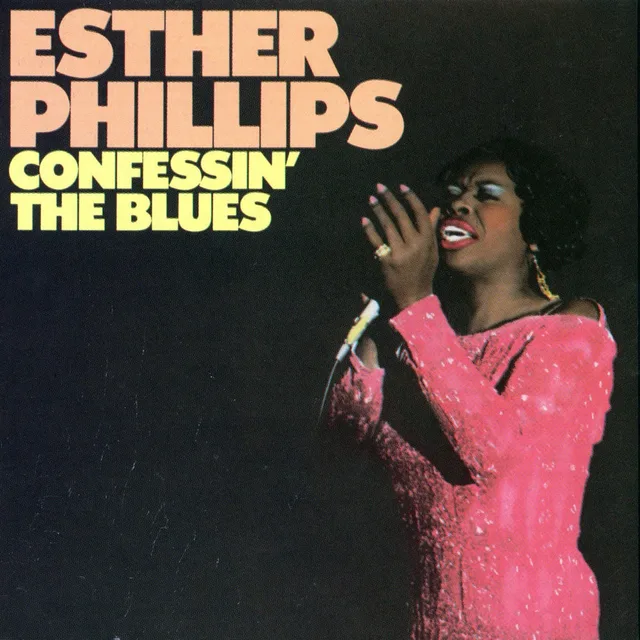
Esther Phillips - Confessin’ the Blues
Released on the Atlantic label, this eleven-track album (44 minutes 55 seconds) fits into a discographic trajectory where Esther Phillips goes from For All We Know (1975) to You've Come A Long Way, Baby (1977). It is a recording that does not seek to seduce the masses of the charts, but rather to assert a rougher sonic identity, more rooted in twelve-bar structures than in smooth harmonies.
1976: The Voice Breaking Free from the Standard
The album marks an assumed departure from Phillips' previous productions, particularly those recorded for Kudu. Contemporary critics highlighted this rupture: the sonic material was judged to be more coherent, carried by an abundance of twelve-bar structures that confer on the record a specific rhythmic density. This approach stands out sharply from the more classical or pop arrangements one might associate with her. In 1976, Esther Phillips did not seek to adapt her voice to current trends; instead, she imposed a framework where melancholy and vocal pleading took precedence over formal elegance. It was a period of clarification for the artist, who distanced herself from pop-soul standard codes to assert a rougher blues identity.
The Absence of Violins as a Sonic Signature
A central element of the production lies in the instrumental choices. The sessions are characterized by a total absence of violins, a technical detail that largely defines the album's tone. This decision yields a drier, more direct sound where Esther Phillips' voice stands out without the soft harmonic layer that strings could have provided. The arrangements, particularly those by Onzy Matthews on side one, are praised for their clever conception and "gutsy" (bold) and "wailing" (plaintive) performance. This orchestral framework, based on a big band, creates a constant rhythmic tension that supports the vocal performance without ever drowning it out. It is a distinct sonic signature: less synthetic or string warmth, more punch and raw intensity.
Two sessions, one confession
The album is actually a juxtaposition of two distinct moments in time. The first side gathers tracks recorded in 1966 with a big band led by Onzy Matthews, while the second side comes from a 1970 session made with a jazz quartet at the Pied Piper Club in Los Angeles. Despite this chronological and instrumental heterogeneity, the eleven songs form a narrative unit around the theme of blues confession. Production is handled by Nesuhi Ertegun and King Curtis, two figures who guarantee the technical quality of a composite recording. Donald Bailey appears on percussion for certain tracks, bringing rhythmic precision that links these two eras. This bicéphale structure allows the album to cover a wide spectrum: from the orchestral swing of the 60s to the more intimate and acoustic jazz of the end of the decade.
The final medley as blues apotheosis
The album closes on a centerpiece: track 11, titled Blow Top Blues / Jelly Blues / Long John Blues. This meditation in the form of a medley is identified by critics as the high point of the set. It is here that Esther Phillips' ability to handle blues structures with intensity reaches its peak. The voice, sometimes described as plaintive or slightly irritating in its high tone, finds an ideal playing field where raw emotion takes precedence over pure technique. This conclusion confirms the coherence of the project: after ten tracks setting the scene, this final track crystallizes the very essence of the album, a barefaced emotional discharge that summarizes the "bittersweet" and tearful approach praised by specialized media outlets.
Summary of an Assertive Vocal Career Trajectory
This is not a commercially driven album, but a recording faithful to a blues identity that gradually distances itself from pop standards. By combining two distinct sessions and betting on instrumentation without violins, the record offers a coherent vision of an artist who prioritizes vocal authenticity over production artifices.
Technical Details
- Release: 1976 - Label: Atlantic - Tracks: 11 (44 min 55 s) - Opening / Closing: I'm Getting 'Long Alright / Blow Top Blues / Jelly Jelly Blues / Long John Blues - Previous Album: For All We Know (with Joe Beck) (1975)
🎬 The album's music videos
11 clips · continuous playback
Tracks
- 1
- 2
- 3
- 4
- 5
- 6
- 7
- 8
- 9
- 10
- 11
🔥 The tracks that are blowing up
Hip-Hop/R&B ranking · week of 12/10/2026
- 1Solar Eclipse— Drake & Don Toliver
- 2Quebec— Drake
- 3I Just Might— Bruno Mars
- 4Cold Shoulder— Drake, Don Toliver & Yebba
- 5Janice STFU— Drake
- 6Dead Fresh— Lil Baby
- 7Classic— Drake
- 8What You Need— Tems
- 9Cinderella— Mac Miller Featuring Ty Dolla $ign
- 10So Good— Jhene Aiko Featuring Kendrick Lamar


