
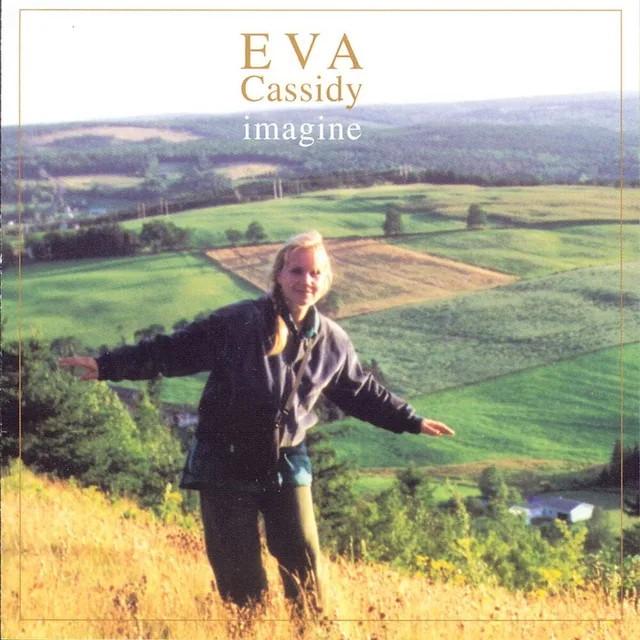
Imagine: the posthumous manifesto of an unfettered voice
Released in August 2002 by Blix Street Records, Imagine is the third studio album — and sixth record overall — from American singer Eva Cassidy. The opus arrives six years after her death, opening a window onto a universe where the artist continues to exist without ever having stopped singing.
Chris Biondo, architect of an acoustic and living sound
The release is distinguished by a resolutely minimalist approach: Chris Biondo is credited as primary producer on several tracks, with the mission of preserving Eva Cassidy's vocal spontaneity. Recording takes place live, rejecting any instrumental or electronic overdubbing that could alter the impression of immediacy. This production strategy places the voice at the center of every track, transforming each song into a pure vocal portrait where the studio's intimacy becomes the only necessary backdrop.
Piano alone, guitar alone: instrumental reduction as dramatic force
The sonic architecture relies on an economy of instruments that functions as an aesthetic choice rather than a budgetary constraint. On It Doesn't Matter Anymore, it is the solo guitar and naked voice that structure the track, while Imagine unfolds with a live-recorded solo guitar by Chris Biondo. The piano steps in on I Can Only Be Me, where it is played by Lenny Williams (2), creating an airy sonic space around the lead vocal. This instrumental restraint does not aim for abstraction but rather reinforces the physical presence of every note, as if each track were a conversation between the singer and her instrument of choice.
Fever and You've Changed: The Tracks That Defy Oblivion Through Vocal Purity
Two tracks in particular illustrate this desire to reduce noise in order to amplify the emotional signal. Fever rests on a drum kit held by Raice McLeod, an organ and synthesizer by Kent Wood, as well as percussion by Darryl Andrews, but it is Eva Cassidy's voice that dominates the arrangement written by Eddie Cooley and John Davenport. You've Changed, for its part, blends Lenny Williams' (2) piano and Chris Biondo's bass within a mix framework where Geoff Gillette's mixing allows the vocal to float above the instruments without ever crushing them. These two tracks demonstrate how a restrained production can become a vector of emotional intensity without resorting to conventional sonic artifices.
Verdict: a posthumous album where the voice alone suffices
Imagine defines itself less by what it contains than by what it refuses: no layering, no guest appearances, no artifice. It is an album that functions like a sound chamber where every track resonates with the same vocal intensity. Whether you listen to "Early Morning Rain," written by Gordon Lightfoot and recorded live by Bryan McCulley, or dive into "Tennessee Waltz" with its solo guitar, the result is always the same: a voice that asks for nothing but attentive presence. Six years after her death, Eva Cassidy proves here that music does not need technology to survive—it only needs a microphone and a voice that knows how to speak the truth without filter.
🎬 The album's music videos
10 clips · continuous playback
Tracks
- 1
- 2
- 3
- 4
- 5
- 6
- 7
- 8
- 9
- 10
🔥 The tracks that are blowing up
Hip-Hop/R&B ranking · week of 12/10/2026
- 1Solar Eclipse— Drake & Don Toliver
- 2Quebec— Drake
- 3I Just Might— Bruno Mars
- 4Cold Shoulder— Drake, Don Toliver & Yebba
- 5Janice STFU— Drake
- 6Dead Fresh— Lil Baby
- 7Classic— Drake
- 8What You Need— Tems
- 9Cinderella— Mac Miller Featuring Ty Dolla $ign
- 10So Good— Jhene Aiko Featuring Kendrick Lamar


