
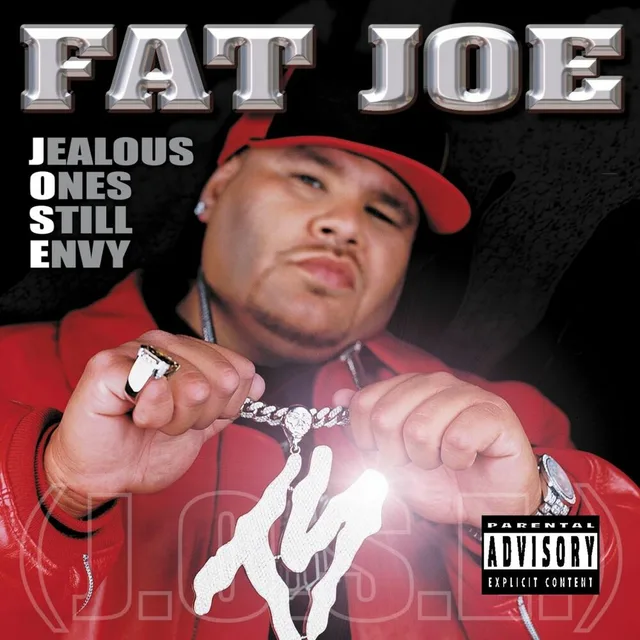
Fat Joe - Jealous Ones Still Envy (J.O.S.E.)
What is the tipping point between raw territorial assertion and melodic chart conquest? It is the tension that structures Jealous Ones Still Envy (J.O.S.E.), Fat Joe's fourth solo studio album. Released on December 4, 2001, by Atlantic Records and Terror Squad Productions, this eighteen-track, one-hour-long J.O.E. does more than add a chapter to the New York rapper's discography; it draws a sharp line between the aggression inherited from Don Cartagena (1998) and the commercial strategy that preceded Loyalty (2002). Originally slated for summer 2000, the album was pushed back before hitting shelves at year-end. This wait did not dilute the project's energy but rather allowed for a densified tracklist where every vocal alliance serves a precise purpose: anchoring local status or expanding national reach.
"My Lifestyle" and "Still Real": The Posture Before the Melody
The album opens with a statement of intent rather than a simple introduction. While "Intro - Main Pass" sets the scene, it is through the tracks signed by Buckwild that Fat Joe's identity crystallizes. On "My Lifestyle," the production provides a dark and direct backdrop that allows the rapper to define his lifestyle without any detours. This approach is reinforced later in the album with "Still Real," also produced by Buckwild, where the stance remains unshakable. These two tracks function as thematic pillars: they remind us that behind the collaborations and melodies, Fat Joe's grounding remains that of a Bronx rapper defending his turf. This duality between raw reality and commercial refinement is at the heart of J.O.S.E.'s strategy.
"King Of N.Y.": Buju Banton and the Stamp of East-Coast Authority
On "King Of N.Y.", produced by Cool & Dre, Fat Joe invites Buju Banton. This association is not incidental within the geography of American hip-hop in 2001. By pairing his voice with that of a major East Coast artist, the rapper reinforces both its local dimension and the status as leader he claims. This track illustrates a desire to consolidate an alliance network strictly anchored on the East Coast, far from the broader sonic experiments that characterize other parts of the album. The presence of Buju Banton acts as a seal of authenticity: it validates Fat Joe's place within the New York ecosystem while offering a powerful vocal dynamic, typical of collaborations between established figures on the East Coast scene at the time.
"We Thuggin'" and "What's Luv?": melodic conquest by R. Kelly and Ashanti
The album then pivots toward a more accessible and melodic aesthetic. On "We Thuggin'", produced by Ron G, Fat Joe collaborates with R. Kelly. This R&B/hip-hop alliance significantly broadens the track's audience reach, adding a pop dimension that contrasts with the aggression of previous songs. Further down the tracklist, "What's Luv?" brings together Ja Rule and Ashanti on productions by Chink Santana and Irv Gotti. This trio perfectly embodies the commercial trend of 2001–2002, where boundaries between rap and R&B blurred in favor of an accessible melody. These two tracks demonstrate that Fat Joe isn't just seeking to affirm his gangsta status but also aims to appeal to a wider audience by playing up sensuality and melodic flow.
The sonic mosaic: fourteen producers serving a multiple identity
The production of Jealous Ones Still Envy (J.O.S.E.) relies on a vast and varied collective of producers. Credits include Buckwild, Irv Gotti, Ron G, Alchemist, Bink!, Chink Santana, Cool & Dre, DJ Nasty, LVM, Psycho Les, Reef, Rockwilder, Sean C, Self, and Younglord. This fragmented production is not a flaw in cohesion, but an assumed strategy to support the thematic diversity of the album. Each producer brings their own texture: Buckwild anchors the darker tracks, Ron G facilitates access to R&B, while others like Reef or Rockwilder offer distinct atmospheres on "Fight Club" or "Murder Rap." This sonic mosaic allows Fat Joe to navigate between several registers without losing the thread of his identity.
Verdict: a commercial performance that validates the strategy
The sonic architecture of the album also relies on a precise distribution of features, where eleven out of eighteen tracks incorporate invited voices. This collaborative density is notably manifested through the recurring presence of Remy Ma, who appears on "Opposites Attract (What They Like)," "Definition Of A Don," and the final track. On this latter one, "We Thuggin' - Remix," she joins a vocal quartet including R. Kelly, Busta Rhymes, and N.O.R.E., creating a unique synergy that closes out the album. This casting strategy highlights specific duos such as the one formed by M.O.P. and Petey Pablo on "Fight Club," or Ludacris paired with Armageddon on "Get The Hell On With That." These occasional associations, produced respectively by Reef and Bink!, illustrate Fat Joe's intent to mobilize distinct figures from the hip-hop landscape to diversify rhythmic textures. Beyond these vocal alliances, the recording process involved extensive geographic logistics. Sessions were held in several New York studios such as TMF Studios, The Crackhouse, and Chung King Studios, but also in Miami with The Hit Factory Criteria and Circle House Studios. This dispersion continued through Orlando at TransContinental Studios, Philadelphia via a local studio, and California thanks to The Enterprise studio. This multi-city journey testifies to a decentralized production that contributed to the richness of the album's sonic textures. In parallel, this release marks a significant commercial milestone: Jealous Ones Still Envy (J.O.S.E.) remains, to this day, Fat Joe's best-selling record, surpassing the performances of predecessors like Represent (1993) or Don Cartagena (1998), and establishing itself as a lasting reference in his discography prior to the arrival of Loyalty (2002). The analysis of the tracklist reveals a precise narrative architecture where interludes play a major structural role beyond their simple decorative function. Between "What's Luv?" and the main title "He's Not Real," the insertion of "He's Not Real - Intro" prepares the ground for this track produced by Richard Frierson, which stages Prospect alongside Remy Ma. This sequence is immediately followed by "The Fuck Up - Interlude," a short passage that acts as a dramatic hinge before the rhythmic explosion of "Get The Hell On With That." The latter title, produced by Bink!, pairs Ludacris and Armageddon to create an aggressive dynamic that contrasts with the softer melodies of previous sections. This alternation between moments of introspection and energy peaks demonstrates a willingness to maintain the listener's attention across the eighteen tracks, avoiding any narrative monotony throughout this hour of music. The collaborative dimension extends to executive production, where Buckwild, The Neptunes, and Scott Storch are credited for their global supervision of the project. This triple artistic direction guarantees sonic coherence despite the diversity of guest producers on each track, such as Reef on "Fight Club" or Rockwilder on "Murder Rap." The presence of these major industry figures validates the album's status as a major release in Fat Joe's discography, fitting logically after Don Cartagena (1998) and before Loyalty (2002). This central position allows the record to capitalize on past successes while preparing the ground for future rapper evolutions, thus confirming its place as a cornerstone piece of his catalog at Atlantic Records. An in-depth analysis of the vocal casting reveals a collaboration architecture that goes beyond simple star accumulation to form a network of precise and documented alliances. Beyond the figures already cited, the tracklist highlights the recurring presence of Prospect, a key member of the Terror Squad collective, who appears on "He's Not Real" alongside Remy Ma and on "The Wild Life" with Xzibit. This double appearance underscores the structural importance of label internal members in constructing the album's narrative, creating a loyalist thread connecting more commercial sections to those anchored in group loyalty. Similarly, Armageddon, another pillar of Fat Joe's New York ecosystem, appears on "Get The Hell On With That" with Ludacris and on "Murder Rap," produced by Rockwilder. These occasional but strategic associations illustrate the rapper's intent to mobilize distinct figures from the hip-hop landscape to diversify rhythmic textures while maintaining strong identity cohesion, where each guest brings their specific energy to serve a global project centered on affirming Fat Joe's status. In the United States, the album reached number 6 on the Top R&B/Hip-Hop Albums chart and number 21 on the Billboard 200. Certified platinum by the RIAA on May 22, 2002, it testifies to solid commercial reception. On an international level, the opus marks a notable breakthrough in the United Kingdom, where it reached number 19 on the UK Albums Chart and was certified Silver by the BPI. This success confirms that the strategy of J.O.S.E.—combining East Coast authority with R&B and West Coast collaborations—enabled Fat Joe to broaden his audience while consolidating his position in the early 2000s American hip-hop landscape.
Technical Specifications
- Release: December 4, 2001 - Label: Atlantic - Tracks: 18 (1 hour 00 minutes) - Opening / Closing: Intro - Main Pass / We Thuggin' - Remix - Guests: Buju Banton, Remy, R. Kelly, M.O.P., Petey Pablo, Ja Rule, Ashanti, Prospect, Ludacris, Armageddon, Xzibit, Busta Rhymes … - Previous Album: Don Cartagena (1998)
🎬 The album's music videos
18 clips · continuous playback
Tracks
- 1
- 2
- 3King of N.Y.feat. Buju Banton
- 4
- 5
- 6
- 7We Thuggin'feat. Busta Rhymes, Noreaga, R. Kelly
- 8Fight Clubfeat. M.O.P., Petey Pablo
- 9
- 10
- 11
- 12
- 13
- 14
- 15Murder Rapfeat. Armageddon
- 16
- 17
- 18
🔥 The tracks that are blowing up
Hip-Hop/R&B ranking · week of 12/10/2026
- 1Solar Eclipse— Drake & Don Toliver
- 2Quebec— Drake
- 3I Just Might— Bruno Mars
- 4Cold Shoulder— Drake, Don Toliver & Yebba
- 5Janice STFU— Drake
- 6Dead Fresh— Lil Baby
- 7Classic— Drake
- 8What You Need— Tems
- 9Cinderella— Mac Miller Featuring Ty Dolla $ign
- 10So Good— Jhene Aiko Featuring Kendrick Lamar


