
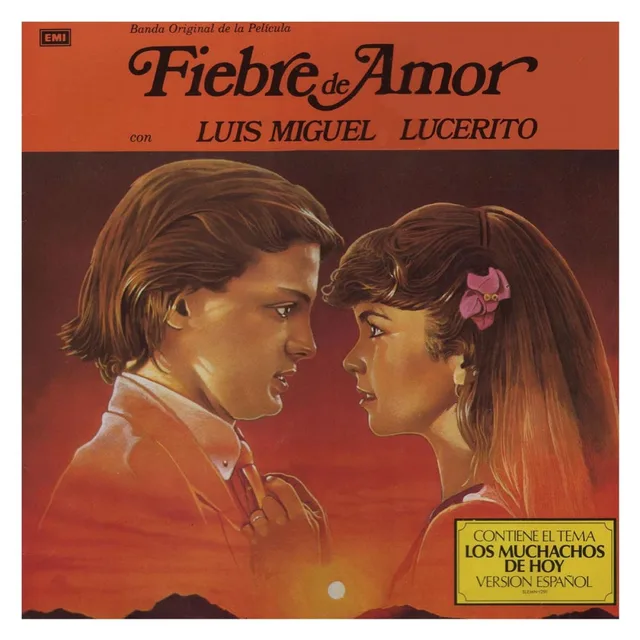
Luis Miguel - Fiebre de amor
Fiebre De Amor ignites the first track, setting a rhythm that runs through this entire soundtrack released in 1985.
Global distribution by EMI Capitol and in Latin America
The record pressing machine ran at full speed for this project released in 1985 via the EMI Capitol label, with a distribution covering Latin America and Europe.
The writing of Luis Rey: when 'Todo El Amor Del Mundo' subverts the film's score
Beyond simply illustrating the thematic elements of the screenplay, certain tracks function as conceptual freeze-frames. Luis Rey is explicitly credited for the tracks Todo El Amor Del Mundo and Siempre Te Seguiré, two titles that propel the album toward a more elaborate dimension than a mere soundtrack extract. The presence of these specific productions changes the dynamic compared to a purely functional record; they offer a strong thematic continuity, anchoring the project in a coherent writing where every note seems to serve a precise intention linked to the visual narrative of the film. These tracks do not merely accompany the action; they transform it into an independent lyrical experience capable of surviving beyond the cinematic screenings.
Massive commercial reception in Mexico in 1985
The commercial reception was immediately massive, with the album selling more than 1,500,000 copies and topping the album charts in Mexico for several weeks. This achievement is not just a statistic; it is the validation of a sound track format that works perfectly as a standalone consumer product. The success was such that the album became a reference for the singer's fans, validating his ability to transform a musical film into a flagship product capable of dominating the national charts.
A cosmopolitan production: a studio album masked by its function as a musical film
There exists a permanent tension between the nature of the studio album and its primary function as a musical film. The album was recorded as part of an entirely musical film, which gives each track an intrinsic cinematic dimension. Yet, the quality of the recordings and the presence of singers like Lucero on certain tracks allow the album to be considered a fully-fledged artistic work, capable of standing on its own outside its visual medium and existing in the living rooms of Latin America.
A discographic pivot between Ya Nunca Más and Canta En Italiano
The soundtrack is part of a precise narrative continuity, since the album was recorded during an open-air concert held at the Convention Center, an event that captured the fan's expectations before the film's release. The international distribution context is also structuring, with a notable presence in Chile where the cassette edition appeared as early as 1985, alongside another illustrated version specifically for the Argentine market. This targeted distribution strategy facilitated the album's establishment in Italy, a country where Luis Miguel already enjoyed established renown, although the cinematic projection required an Italian dubbing to reach the local audience. From a strictly discographic perspective, this opus stands as a major transition in the artist's oeuvre. It immediately complements the romantic explorations of Ya Nunca Más while serving as a direct springboard toward the following series marked by linguistic and stylistic changes, notably Canta En Italiano. This dual function as a bridge between two different stylistic periods reinforces the album's status as a highlight of 1985 in Mexico. The musical density of this ten-track corpus thus consolidates a public image that extends well beyond mere sonic functionality, confirming that this work is much more than a mere visual accompaniment. This pivotal period saw Luis Miguel transform a cinematic event into a massive success thanks to a clever distribution strategy that launched the album throughout Latin America before propelling it toward Europe, notably in Italy, where it met a receptive audience from its release. The international dimension materialized through specific editions, such as the one for Chile that appeared on cassette as early as 1985, and an illustrated version dedicated to the Argentine market, attesting to an approach adapted to different geographical regions without ever compromising established reference dates. The sonic experience was enriched by the participation of Lucerito, also known as Lucero, who contributed to certain tracks as a singer within the musical project. Their collaboration proved fruitful, leading Lucero to perform several of the songs in her own concerts thereafter, which extended the impact of this album well beyond the original recording sessions. The film itself, entirely musical and shot during an open-air concert at the Convention Center, served as a unique setting to capture the expectations of an immense fan base before the official release of the feature film. This dual function, both as a visual support and a standalone work capable of surviving cinematic screenings, enabled Luis Miguel to solidify his status as a popular icon while preparing the ground for his future linguistic and stylistic explorations, thus validating the idea that this soundtrack was much more than a mere musical accompaniment. Fiebre De Amor should not be seen as an isolated episode, but rather as the pivot that connects the previous studio album Ya Nunca Más to the following opus Canta En Italiano. This central position in the discography allows the singer to affirm a new musical identity while retaining the codes of romantic pop-ballad that have enabled him to evolve since 1984. Between these three discs, we observe a maturation where the singer uses the international platform provided by the soundtrack to prepare for his future forays into different linguistic and stylistic territories.
Technical details
- Release date : 1985 - Label : EMI Music México - Tracks : 10 (36 min 56 s) - Opening / closing : Fiebre De Amor / Los Muchachos De Hoy - Previous album : Ya Nunca Más (1984)
🎬 The album's music videos
10 clips · continuous playback
Tracks
- 1
- 2
- 3
- 4
- 5
- 6
- 7
- 8
- 9
- 10
🔥 The tracks that are blowing up
Hip-Hop/R&B ranking · week of 26/10/2026
- 1I Just Might— Bruno Mars
- 2Janice STFU— Drake
- 3What You Need— Tems
- 4Solar Eclipse— Drake & Don Toliver
- 5Dead Fresh— Lil Baby
- 6Quebec— Drake
- 7So Good— Jhene Aiko Featuring Kendrick Lamar
- 8WTF GOIN— Belly Gang Kushington & 21 Savage
- 9Cold Shoulder— Drake, Don Toliver & Yebba
- 10Cinderella— Mac Miller Featuring Ty Dolla $ign