
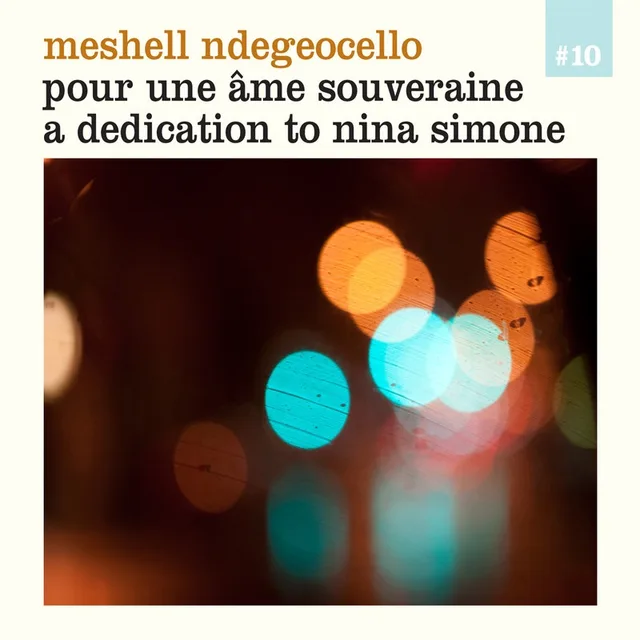
Me'Shell NdegéOcello - Pour une âme souveraine - A Dedication to Nina Simone
For a Sovereign Soul: An Intergenerational Dialogue with Nina Simone
He immediately sets the stage for a living collage where Meshell Ndegeocello and Chris Bruce's polished production serves as a backdrop to distinct female voices that reactivate the original lyrics without betraying them. The album's thesis is clear: it is not a pastiche, but an act of transmission where each guest embodies a specific facet of Nina Simone's legacy.
The Seven Female Voices as the Project's Spine
If conceptual coherence relies on a rigorous selection of fourteen signature tracks, it is the seven vocal collaborations that form the backbone of this project. Toshi Reagon appears on two tracks: Real and House Of The Rising Sun. On Real, her soul/jazz voice immediately reinforces the spiritual and feminine dimension of the track, while on House Of The Rising Sun, her presence adds a warm and intimate vocal texture to this traditional classic. Sinéad O'Connor follows up on Don't Take All Night. Her raspy timbre and direct interpretation bring raw emotional weight that seeks no superfluous elegance, marrying perfectly with the spirit of the original text. Lizz Wright then takes over on Nobody's Fault But Mine, where her soft and warm voice completes the melody of Nina Simone's track. Further down the album, Valerie June appears on Be My Husband. Her folk-blues style brings a mystical and organic atmosphere that transforms the hymn into an intimate prayer. The continuity continues with Tracy Wannomae on See Line Woman, whose voice adds a soul/funk dimension that energizes the arrangement of the original track, followed by Cody ChesnuTT closing the cycle of collaborations on To Be Young, Gifted And Black. His hip-hop/neo-soul style brings a contemporary and rhythmic touch to this civil rights hymn, anchoring the project in modernity while respecting its historical gravity.
Fourteen iconic tracks revisited without betraying the original
Beyond these seven collaborations, the album offers a rigorous selection that includes tracks like Suzanne, Turn Me On, Feeling Good, Black Is The Color Of My True Loves Hair and Either Way I Lose. These five tracks feature no visible guests, which could create a disconnect with expectations tied to collaborations. Yet, it is precisely this alternation between solo tracks and featuring that gives the album its texture: some pieces focus solely on Meshell Ndegeocello's voice, while others are enriched by an external presence. This oscillation avoids the risk of a project where every track does exactly the same thing.
A polished production that unites vocal and instrumental textures
Every arrangement maintains its own signature while contributing to a cohesive sonic ecosystem, where Meshell Ndegeocello's jazz-soul-folk finds its natural place alongside Nina Simone originals. The absence of guests on five tracks does not dilute the unity of the project; rather, it allows the lead voice to breathe and dialogue with the lyrics without needing an additional presence for every track.
Critical verdict: a tribute that functions as a living chain
Officially released on October 16, 2012, under the aegis of Motéma Music label, this album marks a major milestone in Meshell Ndegeocello's discography. As the artist's tenth studio effort, it positions itself between Weather (2011) and Comet, Come to Me (2014), thereby extending her socially engaged artistic trajectory that began as early as the 90s with Plantation Lullabies. Production is handled via co-production by Meshell Ndegeocello and Chris Bruce, ensuring a creative approach that transcends simple pastiche to establish genuine transmission. The album's structure is framed by two emblematic tracks: Please Don't Let Me Be Misunderstood opens track 1, while Four Women closes the series on the fourteenth and final track. This architecture allows for direct dialogue with Nina Simone's original lyrics, whose social and musical legacy is reactivated here through a rigorous selection of revisited compositions. Pour une âme souveraine distinguishes itself from generic homages by its ability to make each interpretation a link in a living chain. The sovereignty of Nina Simone is not merely preserved; it is reinvented through these seven distinct voices and five solos that together form a collective work. It is not an album where one seeks to surpass the original through performance, but rather an album where every track becomes a bridge between two generations of musicians, connecting past to present without ever betraying the spirit of the revisited lyrics.
Technical Details
- Tracks: 14 - Opening / Closing: Please Don't Let Me Be Misunderstood / Four Women - Guests: Toshi Reagon, Sinéad O'Connor, Lizz Wright, Valerie June, Tracy Wannomae, Cody ChesnuTT
🎬 The album's music videos
14 clips · continuous playback
Tracks
- 1
- 2
- 3Real Realfeat. Toshi Reagon
- 4
- 5
- 6
- 7
- 8
- 9
- 10
- 11
- 12
- 13
- 14
🔥 The tracks that are blowing up
Hip-Hop/R&B ranking · week of 12/10/2026
- 1Solar Eclipse— Drake & Don Toliver
- 2Quebec— Drake
- 3I Just Might— Bruno Mars
- 4Cold Shoulder— Drake, Don Toliver & Yebba
- 5Janice STFU— Drake
- 6Dead Fresh— Lil Baby
- 7Classic— Drake
- 8What You Need— Tems
- 9Cinderella— Mac Miller Featuring Ty Dolla $ign
- 10So Good— Jhene Aiko Featuring Kendrick Lamar


