
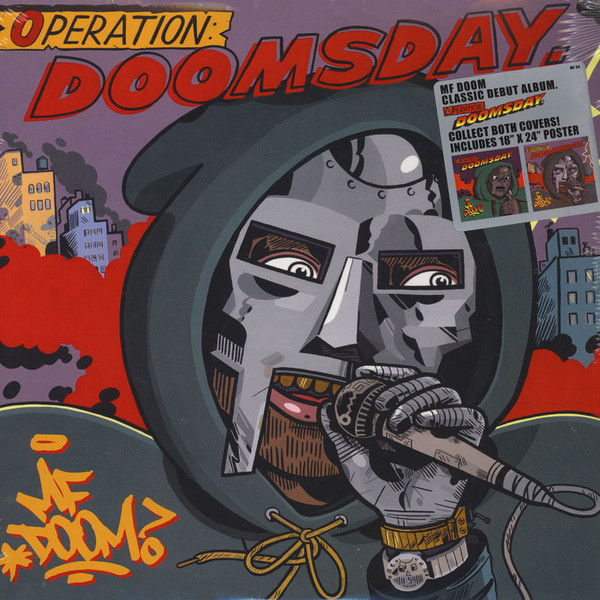
MF DOOM - Operation: Doomsday
The Ghost of KMD: A Look Back at Elektra Records and the Birth of an Independent Project
The shadow of departure still hovers over the album. After his abrupt split with Elektra Records, Daniel Dumile didn't just disappear; he chose to reinvent himself alone. Operation: Doomsday, released on October 19, 1999, via the independent label Fondle 'em Records, is not merely a follow-up to KMD; it is a manifesto of independence. Far from the commercial circuits that "ruined his life," the album builds itself like a sonic fortress where every track serves as a line of defense against old constraints. MF DOOM's trajectory is written here through breaks: between the group KMD and this first solo album, there is a gap that the artist bridges with flawless samples and rap from elsewhere.
Production as Weapon: Flawless Samples and Distinct Sonic Aesthetic
The production of Operation: Doomsday is characterized by surgical precision. The samples, chosen and edited with care, serve not only as a backdrop; they constitute the framework upon which MF DOOM's flow unfolds. The sonic aesthetic does not attempt to imitate the great producers of the 90s New York scene; it creates an atmosphere unique to Daniel Dumile. This production allows the artist's unstoppable rap to exercise itself on raw material where every sample is a clue, a piece of the puzzle that reconstructs an identity shattered by the industry.
The Choir of Impostors: 8 Featurings That Rebuild a Broken Identity
If MF DOOM presents himself as a lone wolf, he is not entirely isolated. Eight tracks include a feature, and each of these guests plays a precise role in the identity reconstruction of the album. On "Doomsday," Pebbles the Invisible Girl offers her presence on the eponymous track, adding a vocal texture that contrasts with Dumile's usual textual austerity. DJ Cucumber Slice steps in on "Rhymes Like Dimes" to anchor the track into a more rhythmic and urban register. Tommy Gunn makes an appearance on "The Finest," bringing raw energy that recalls the roots of the KMD group without erasing MF DOOM's solo identity. King Geedorah features on two tracks: "Red and Gold" and "Who You Think I Am?". On the first, he offers a warm presence that tempers the track's aggression; on the second, his voice blends with those of Kong, Kwite Def, Megalon, Rodan, and X-Ray to form a polyphonic choir that transforms the song into a collective scene. Finally, Megalon reappears on "Operation: Greenbacks," while Kurious signs a feature on an unnamed track, completing this gallery of secondary characters that populate the album's universe without ever stealing the spotlight from its primary creator.
Verdict: A concept album where creative solitude becomes strength against the industry
The internal structure of the album reveals a commitment to exhaustiveness that goes beyond the conventional scope of a record. Of the 42 tracks in total, more than one-third are dedicated to alternative and instrumental versions, transforming Operation: Doomsday into a comprehensive study object rather than a simple album for immediate consumption. Tracks 20 through 36 constitute a detailed sonic archive: the original versions of the songs "Dead Bent," "Gas Drawls," and "Hey!" are presented in their 12" format, while the instrumental versions of these same tracks add to tracks 30 through 36. This architecture allows one to listen to the album in its entirety, including its raw or vocal-less facets, as if MF DOOM were offering the public a complete library of his compositions. Track 19, "Hero vs. Villain (Epilogue)," serves as the narrative conclusion to this sonic exploration before the list ends with an unnamed track presented as an instrumental. This structural arrangement reinforces the idea that the record is designed as a linear and exhaustive experience, where every track—whether it be a studio version, an alternative mix, or an instrumental—contributes to the construction of Daniel Dumile's overall sonic universe. Operation: Doomsday does no more than mark MF DOOM's return; it reconstructs a fractured identity through tracks, samples, and features. Between the solitude of the ghost and the choir of imposters, the album functions as a manifesto of independence where every track is proof that Daniel Dumile can compose his own story, far from the circuits that previously ruined him. It will be followed by MM..FOOD (2004) and Born Like This (2009), but this first record remains the starting point of a solo career where production, features, and the structure itself of the album—42 tracks with more than one-third being alternative or instrumental versions—participate in a rigorous sonic architecture.
Technical Details
- Release Date: October 19, 1999 - Label: Fondle 'em Records - Tracks: 42 - Opening / Closing: The Time We Faced Doom (skit) / ? (instrumental) - Guests: Pebbles the Invisible Girl, DJ Cucumber Slice, Tommy Gunn, MF Grimm, King Geedorah, Kong, Kwite Def, Megalon, Rodan, X-Ray, Kurious
🎬 The album's music videos
19 clips · continuous playback
Tracks
- 1
- 2
- 3
- 4The Finestfeat. Tommy Gunn
- 5
- 6
- 7Tick, Tick…feat. MF Grimm
- 8
- 9
- 10
- 11
- 12
- 13
- 14
- 15
- 16
- 17
- 18
- 19
🔥 The tracks that are blowing up
Hip-Hop/R&B ranking · week of 12/10/2026
- 1Solar Eclipse— Drake & Don Toliver
- 2Quebec— Drake
- 3I Just Might— Bruno Mars
- 4Cold Shoulder— Drake, Don Toliver & Yebba
- 5Janice STFU— Drake
- 6Dead Fresh— Lil Baby
- 7Classic— Drake
- 8What You Need— Tems
- 9Cinderella— Mac Miller Featuring Ty Dolla $ign
- 10So Good— Jhene Aiko Featuring Kendrick Lamar


