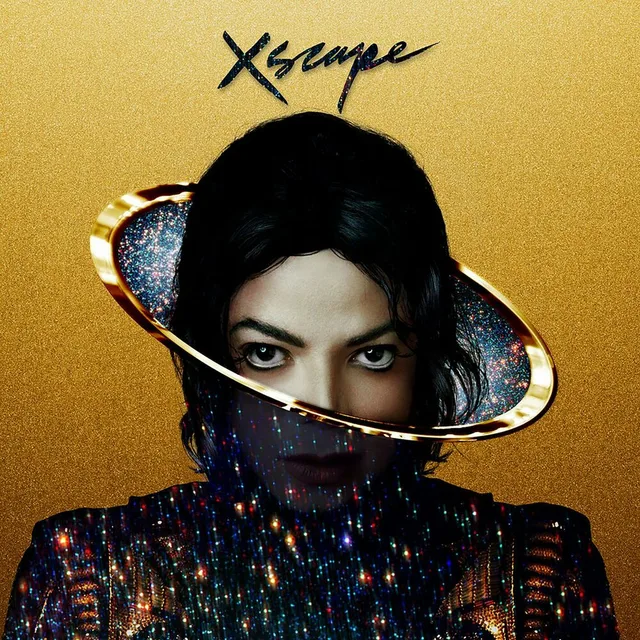
The album opens with a question of production that runs through the entire record: how does the voice of the dead resonate when the producer imposes his own sonic grid? Track 1, Love Never Felt So Good, immediately positions itself as the narrative pivot of the project. It doesn't simply close a recording; it initiates a loop that closes on the final track (track 17) to form a perfect circular structure. This dual version – one modern side, the other raw and archived – creates from the first listen a tension between past and present, as if the entire album were a dialogue with its own memory.
The Timbaland/Harmon vs. Larry Gold dichotomy: between electro-pop and orchestration
The heart of the remastered section (tracks 1 to 8) is dominated by a very clear production alliance. But this modernity isn't monolithic: these orchestral passages offer direct contrast with the dominant electronic texture, creating an internal dichotomy within the record where modern pop rubs against classical orchestration. Track 4, A Place with No Name, marks elsewhere a notable stylistic rupture: produced here by Stargate, it distances itself from the Timbaland/Harmon model and introduces a sonic variation that breaks the internal coherence of the main production.
The absence of mixing for tracks 9-16: a technical flaw in the posthumous narrative
The dichotomy becomes even sharper: tracks 1 through 8 benefit from a polished studio treatment, while tracks 9 through 16 remain in their raw state, like sound fossils preserved without filter. This configuration transforms Xscape into a temporal ark where every listen becomes a journey between two eras: the King of Pop reinvented by Timbaland facing himself, as he was recorded twenty or thirty years ago.
Verdict: Between myth and archive
The production of Xscape rests on a rigorously defined technical architecture established by the division of labor among the various engineers and producers. Rodney Jerkins serves as the mixer on track 8 (Xscape), alongside Jaycen Joshua and Trehy Harris, confirming a collaborative approach where each track is handled by a specific set of engineers (Jeff Chestek, Karl Petersen, Chris Godbey, Phil Tan) according to precise roles: assistant engineer, primary mixing, or assisted mixing. This technical division explains the textural diversity of the album, which alternates between string arrangements orchestrated by Larry Gold on tracks 5 through 8 and electronic productions dominated by Timbaland. Track 4 (A Place With No Name) stands out distinctly as it was produced by Stargate (Mikkel S. Eriksen and Tor E. Hermansen), with Daniela Rivera serving as the assistant engineer, introducing a stylistic variation within the remastered block. Tracks 9 through 16 are original versions that were not mixed, preserving their raw recording state from between 1980 and 1999, while tracks 1 through 3 and 5 through 8 benefit from complete studio treatment including final mixing. The collaborative dimension of Xscape goes beyond Justin Timberlake's presence on the eponymous track and track 17; it is rooted in a logic of reactivating Michael Jackson's personal archives. This archival approach transforms the album into a kind of sonic museum where Michael Jackson's original voices are reactivated by contemporary producers. Timbaland, the primary producer on most remastered tracks, imposes an electronic soundscape that deliberately contrasts with the classical orchestration by Larry Gold on tracks 5 through 8. This tension between past and present is accentuated by Paul Anka's credited production role on the final version of Love Never Felt So Good, adding another layer of generational heritage to the project. The album's very structure, with its 17 tracks distributed between remastered versions and original unmixed versions, reinforces this idea of temporal dialogue. Tracks 9 through 16, preserved in their raw state, act as sonic fossils that remind us Michael Jackson died in 2009, leaving behind an immense catalog from which Xscape represents only a fraction. The album defines itself less as an original work than as a mise-en-abyme of the legendary status of its author, where each track is a fragment of a past that cannot be entirely resurrected. The presence of figures like Timbaland, Stargate, or Rodney Jerkins on tracks recorded more than two decades ago perfectly illustrates this notion of posthumous reactualization, where executive producer L.A. Reid, under the banner of Epic Records, decides the sonic fate of a deceased artist by giving him a second life through collaborations with living artists. Xscape defines itself primarily as an album of transition. It does not provide the continuity of a classic studio record but functions rather as a mise-en-abyme of its author's legendary status. Justin Timberlake's presence on the opening and closing acts serves as a generational anchor, linking contemporary pop aesthetics to a past that can only be resurrected through the medium of another living artist. The album remains a hybrid object: both posthumous homage and reactualization project, it interrogates the very notion of discorial integrity when the executive producer – here L.A. Reid, under the banner of Epic Records – decides the sonic fate of a deceased artist.
Technical Specifications
- Release Date: May 9, 2014 - Record Label: Epic - Tracks: 17 (1 h 13 min) - Opening / Closing Track: Love Never Felt So Good / Love Never Felt So Good - Guests: Justin Timberlake
🎬 The album's music videos
8 clips · continuous playback
Tracks
- 1
- 2
- 3
- 4
- 5
- 6
- 7
- 8
🔥 The tracks that are blowing up
Hip-Hop/R&B ranking · week of 12/10/2026
- 1Solar Eclipse— Drake & Don Toliver
- 2Quebec— Drake
- 3I Just Might— Bruno Mars
- 4Cold Shoulder— Drake, Don Toliver & Yebba
- 5Janice STFU— Drake
- 6Dead Fresh— Lil Baby
- 7Classic— Drake
- 8What You Need— Tems
- 9Cinderella— Mac Miller Featuring Ty Dolla $ign
- 10So Good— Jhene Aiko Featuring Kendrick Lamar