
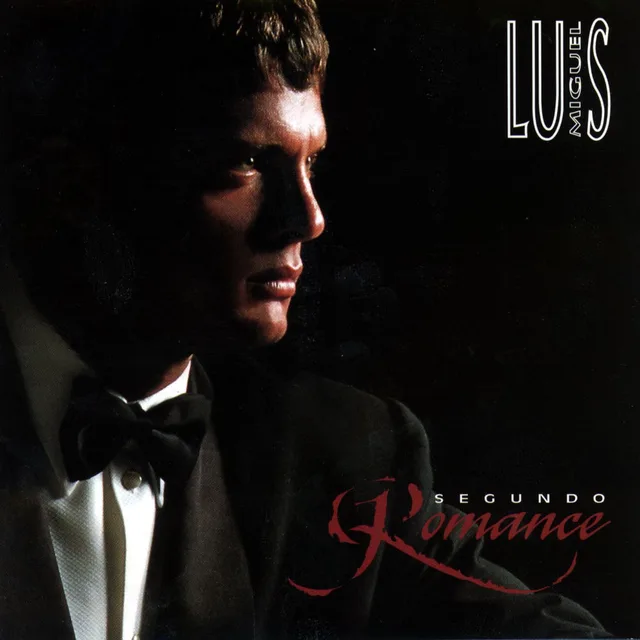
Miguel - Segundo romance
El Día Que Me Quieras doesn't open the album like a simple prelude; it poses an immediate question: how to reinvent a classic bolero melody without betraying it? On Segundo Romance, Luis Miguel isn't trying to hide his roots' heritage, but rather magnify it through orchestral arrangements that give full density to the original track. This choice defines the entire album: there are no featured artists credited to dilute the lead voice; every song is a solo reinterpretation of a standard written between 1934 and 1993, recorded in early 1994 at Record Plant in Los Angeles.
Segundo Romance: the tenth studio album, direct heir to Romance (1991)
Released on August 30, 1994, via WEA Records, this album is the tenth studio project by the Mexican singer. It follows directly in the footsteps of Romance (1991), which had already solidified his place as an international Latin crooner. Segundo Romance does not break new ground; it deepens the melodic ambition launched two years prior, tackling a more ancient and demanding corpus: Latin ballads written between 1934 and 1993. Between Directo al corazón (1982) and Romance (1991), Luis Miguel had already laid the foundations for an international career, but here he returns to the source with a rigor that leaves no room for improvisation. The promotion of this album was carried out via tours in the United States and Latin America from August to December 1994, confirming that the project was conceived as much as a live event as a studio product.
El Día Que Me Quieras: the opening track that anchors the album in bolero tradition
The first track on the album is a cover of Carlos Gardel and Alfredo Le Pera. It is not a modern interpolation; it is a faithful rendition of classic bolero codes, carried by a voice that knows how to navigate between classical melancholy and pop intensity. The production, handled by Luis Miguel himself, Juan Carlos Calderón, Kiko Cibrian, and Armando Manzanero, rests on an arrangement that gives full place to the strings and brass without ever suffocating the vocals. This opening choice is strategic: it immediately sets the expectation that the entire album will be a series of respectful but worked reinterpretations.
La Media Vuelta and Delirio: The Orchestral Pillars of a Return to Roots
Midway through the album, La Media Vuelta relies on a trumpet solo by Ramon Flores that gives the ballad a festive dimension without renouncing its melancholy. These two tracks show that the album does not merely reproduce an inheritance; it makes an active dialogue with modern production. The typical bolero orchestral arrangements are here put to service of a structure that alternates between the restraint of pop ballads and instrumental bursts.
Verdict: An Album That Consolidates Luis Miguel's Place Between Latin Tradition and International Stage
On Solamente Una Vez, Tomy Morgan's harmonica fits seamlessly into an arrangement that scrupulously honors the spirit of the bolero while giving it a modern resonance. Similarly, on Nosotros, Jeff Nathanson adds his breath to the saxophone to underscore the melancholy of Pedro Junco Jr.'s lyrics, while Ramon Flores' trumpet solo on La Media Vuelta lends a festive dimension to José Alfredo Jiménez's composition. These instrumental interventions are far from mere ornaments; they structure the album as a constant dialogue between the original voices of composers like Carlos Gardel or Agustín Lara and Luis Miguel's contemporary execution. All eleven tracks, from first to last, form a stylistic coherence where every orchestral arrangement serves to magnify Latin tradition without ever betraying its origins. From El Día Que Me Quieras to Delirio, the album presents itself not as a simple collection of melodies but as a unified work that affirms Luis Miguel's place between heritage and the international stage. This rigor in reinterpreting standards written between 1934 and 1993 confirms that Segundo Romance is far more than an album of covers: it is a lasting affirmation of bolero art, recorded early 1994 in Los Angeles and promoted via tours that made this opus a major cultural event in the region. Segundo Romance does not seek to innovate sonically but succeeds in transforming a series of covers into a coherent work. It is not merely a collection of songs; it is an album that affirms Luis Miguel's place as heir and interpreter of a living tradition. Between El Día Que Me Quieras and Delirio, the album constructs a journey where each track refers to a specific era or emotion, never repeating itself. The Mexican singer's tenth studio album remains thus a lasting reference on the Latin American scene—an album that proves one can revisit classics without betraying either their form or their soul.
Technical Specifications
- Release: August 30, 1994 - Label: WEA Records - Tracks: 11 - Opening / Closing: "El Día Que Me Quieras" / "Delirio"
🎬 The album's music videos
11 clips · continuous playback
Tracks
- 1
- 2
- 3
- 4
- 5
- 6
- 7
- 8
- 9
- 10
- 11
🔥 The tracks that are blowing up
Hip-Hop/R&B ranking · week of 12/10/2026
- 1Solar Eclipse— Drake & Don Toliver
- 2Quebec— Drake
- 3I Just Might— Bruno Mars
- 4Cold Shoulder— Drake, Don Toliver & Yebba
- 5Janice STFU— Drake
- 6Dead Fresh— Lil Baby
- 7Classic— Drake
- 8What You Need— Tems
- 9Cinderella— Mac Miller Featuring Ty Dolla $ign
- 10So Good— Jhene Aiko Featuring Kendrick Lamar


