
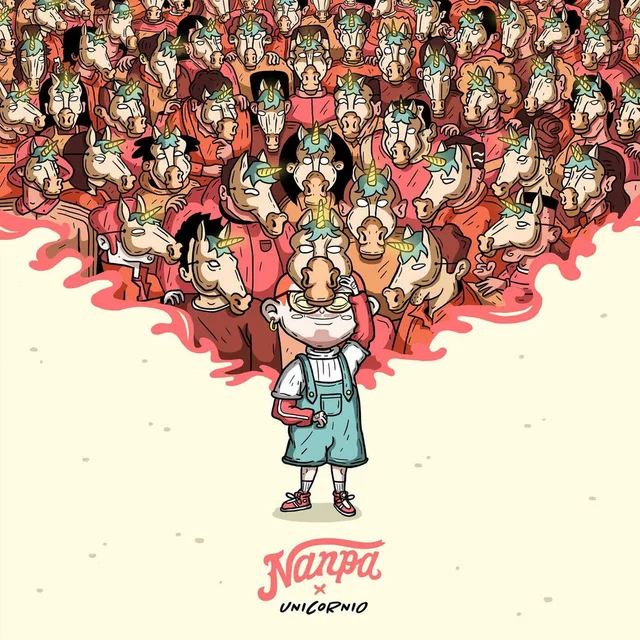
Nanpa Básico - Unicornio
Since the release of Las Que No Estaban until the arrival of Los No Tan Tristes, Nanpa Básico's trajectory comes to a halt in 2020 with the release of their studio album, Unicornio. This album, available on the group's own label, does not attempt to expand beyond its own universe through massive collaborations. Instead, it establishes itself as an autonomous, textural fortress, framed by a classic but resolutely directive structure.
A pivotal album for Nanpa Básico in 2020
The total length of the project is 35 minutes and 30 seconds, a conciseness that invites immediate listening without unnecessary embellishments. Released on November 13, 2020, Unicornio officially places the artist's career within the lineage of Nanpa Básico's production. It consolidates the work initiated with previous compilations, such as Compilado in 2015 or Según nosotros in 2016, and sits between the two studio albums documented: Las Que No Estaban (2020) and Los No Tan Tristes (2021). The album does not present itself as a radical break, but as a necessary link in a coherent artistic continuity. It marks a transitional phase in the discography, serving as a bridge between the exploratory phases and the maturity that is expected with the next album, Los No Tan Tristes.
A strictly solo narrative and sonic architecture
The album's structure is based on strict time markers that define its narrative architecture. The opening track, positioned at track number one on the tracklist, is Después de las 12. It immediately establishes the initial framework of this new adventure, serving as a mandatory entry point before leading into the eleven other tracks that follow. In contrast to this opening, the album closes with track twelve, Amores Veloces. This track concludes the listening experience, giving the studio project a cyclical coherence. Between these two markers, the artist constructs a path that remains consistent with their individual style, confirming that the album functions as a self-contained and autonomous entity within their official discography. The very structure of the studio album reveals a desire to focus on personal songwriting. There is no vocal layering to expand the sound or complicate the vocal landscape, except for a single, specific moment. This notable absence of external collaborations underscores a firmly established solo approach, where the artist's voice carries the weight of the lyrics without the need for counterpoint or contrast provided by other performers.
A single collaboration with Jamie Fine for contrast
Within this solitary work, the fourth track, No Sé Qué Somos (feat. Jamie Fine), represents the only confirmed external connection to the entire project. On this particular track, Nanpa Básico combines his vocals with those of Jamie Fine. The presence of a featured artist on the album marks a deliberate isolation within a sea of solo tracks. The collaboration is not featured on multiple tracks; instead, it is concentrated here to give this unique piece a specific collaborative dimension, without extending this formula to other tracks. This occasional collaboration serves as a minimalist contrast to the overall structure of the album, demonstrating that the artist knows how to incorporate another vocal energy without making it a recurring or systematic element. It is a calculated exception that enriches the texture of the album without compromising its dominant solo identity.
From a purely technical standpoint, the studio album adheres to the conventions of a classic album. The total running time of 35 minutes and 30 seconds allows for a relaxed listening experience, as the various verses and rhymes are presented throughout the tracks. This project does not aim for extreme density or fragmentation, but rather a balance between openness, central sections, and a concluding piece. The tracklist, from Después de las 12 to Amores Veloces, forms a coherent sequence that justifies this length and number of tracks. The format is simple, classic, and perfectly calibrated to carry the artistic message of the album without being excessive or lacking in substance.
Ultimately, the studio album confirms Nanpa Básico's artistic credibility. Between Compilado, Vol. 1 in 2017 and Los no tan tristes in 2021, this album marks a crucial step in solidifying the artist's image. It does not seek to align with the collaborative trends of the moment, but rather validates a position where the authenticity of the solo voice is paramount. This is an album that consolidates the artist's history, clearly situated between two other key works: Las Que No Estaban (2020) and Los No Tan Tristes (2021). It remains a cornerstone of this discography, a record that does not compromise on its demand for coherence, where each track is important, where the collaboration with Jamie Fine remains the only point of exchange, and where the length and structure serve the message.
Technical specifications
- Release Date: November 13, 2020 - Label: Nanpa Básico - Tracks: 12 (35 minutes 30 seconds) - Opening / Closing: Después de las 12 / Amores Veloces - Guest Artists: Jamie Fine - Previous Album: Las Que No Estaban (2020)
🎬 The album's music videos
12 clips · continuous playback
Tracks
- 1
- 2
- 3
- 4
- 5
- 6
- 7
- 8
- 9
- 10
- 11
- 12
🔥 The tracks that are blowing up
Hip-Hop/R&B ranking · week of 26/10/2026
- 1I Just Might— Bruno Mars
- 2Janice STFU— Drake
- 3What You Need— Tems
- 4Solar Eclipse— Drake & Don Toliver
- 5Dead Fresh— Lil Baby
- 6Quebec— Drake
- 7So Good— Jhene Aiko Featuring Kendrick Lamar
- 8WTF GOIN— Belly Gang Kushington & 21 Savage
- 9Cold Shoulder— Drake, Don Toliver & Yebba
- 10Cinderella— Mac Miller Featuring Ty Dolla $ign