
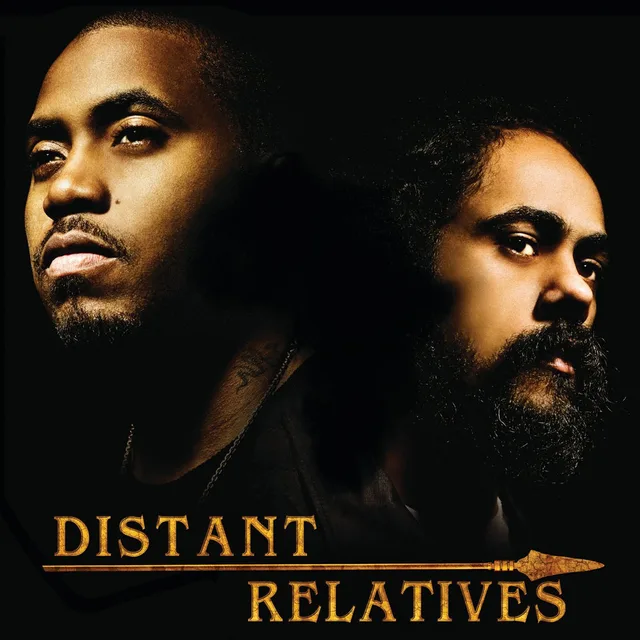
There is a sonic architecture where reggae transforms into political weaponry, forged by the hands of the Marley brothers and nourished by Nas's New York roots. Between 2008 and 2010, recording sessions saw Damian Marley and his brother Stephen compose a ground for hip-hop and reggae to meet, ensuring the fusion did not become merely aesthetic cohabitation. Live sound dominates; instrumentation breathes within the room, with African samples permeating every track. The stakes were clear from the start: avoid the corny pitfall that haunts charity albums, aiming for a natural-sounding record playable in a car while integrating a dense pan-African consciousness. The result, released by Universal Republic Records on May 14, 2010, stands as thirteen tracks spanning an hour of listening time, without excess or inflated duration.
Live production and African samples: the rejection of corny aesthetics
Production is primarily handled by Damian Marley and Stephen Marley. They built a sound where the presence of real instruments takes precedence over synthesizers or digital loops. The choice of live instrumentation, coupled with African musical samples, allows for an organic texture on the album. This isn't a collage of exotic sounds placed superficially: the sample becomes integral to the groove, it inserts itself into the melody, and it dialogues with the drums and strings. The rigor of this approach explains why the record resists the sentimental or kitsch drift often associated with community projects.
K'NAAN on Tribes At War and Africa Must Wake Up: the Pan-African dimension
Where the album gains in political density is with K'NAAN. He appears twice on the record. On Tribes At War, he slots into the second position of the tracklist. His presence immediately reinforces the Pan-African dimension of the project: a Canadian artist of Somali origin, he lends his voice to the discourse on colonial heritage and identity tensions. He returns in full force on the final track, Africa Must Wake Up, which closes the record at the thirteenth position. This double presence anchors the album in territorial and historical commitment: K'NAAN isn't there for a decorative appearance; he serves as the backbone of the record's message.
Dennis Brown on Land Of Promise: a touch of historical classicism
At number eight on the album, Land Of Promise, welcomes Dennis Brown. He is a legendary Jamaican reggae artist whose voice adds a classic and deep dimension to the project. His contribution does not seek to renew the sound but rather places the album within a historical lineage of reggae. The presence of Dennis Brown functions as a bridge between generations: it reminds us that reggae is above all a living culture, carried by voices that marked the previous decade.
Stephen Marley on Leaders and In His Own Words: the family cohesion of the project
Stephen Marley appears twice on the album. On Leaders, he steps in at number four on the tracklist. At number nine, it is on In His Own Words that he returns to the mix.
Lil Wayne and Joss Stone on My Generation: expanding toward R&B
At number twelve, My Generation marks a stylistic turn with a double featuring. Lil Wayne appears alongside Joss Stone. The duo introduces a touch of soul and contemporary rap that broadens the album's sonic palette. Here, invited by Nas, Lil Wayne brings his characteristic flow and deep voice, while Joss Stone delivers a pure soul melody. This combination functions as an anchor toward R&B without betraying the project's reggae identity. The track fits within the continuity of collaborations with Damian Marley while opening up to another vocal and harmonic register.
The collaboration between Nas and Damian Marley continues their artistic relationship that began in 2005, when the New York rapper had already been invited by Damian on "Road to Zion," which appeared on the album Welcome to Jamrock. This first meeting laid the groundwork for an alliance that culminates with Distant Relatives, released on May 14, 2010. The album is chronologically positioned between two major works of Nas: it follows Hip Hop Is Dead (2006) and precedes Life Is Good (2012). The release date of the record, May 14, 2010, is confirmed by official sources, although some references mention a publication on May 18; the version retained here favors the May 14 date. Recording sessions took place between 2008 and 2010, alternating between Los Angeles and Miami, which explains the diversity of sonic atmospheres present on the record. The Marley brothers, Damian and Stephen, assumed primary production duties for the album, using live instrumentation to avoid the artificial effects often associated with charitable projects. Their goal was clear: create a sound that is drivable in a car, natural and organic, without falling into kitsch. African samples are integrated rigorously, serving as melodic foundations rather than exotic ornamentation. The album reached fifth place on the Billboard 200 in the United States during its first week, selling 57,000 copies. Critics praised the conceptual approach of the project, highlighting particularly thematic coherence around pan-Africanism and colonial heritage. Distant Relatives succeeds at its basic goal: it does not slip into the cliché of the charity record. The live production by the Marley brothers, Nas's New York anchoring, and carefully chosen features construct a coherent musical object. Reggae is no longer just a sonic color; it becomes a tool for political expression, carried by lyrics that revolve around colonialism, poverty, and human universality. They are not solos, but their lack of credited partner on the official tracklist places them in a shadow zone where one loses a bit of the dramatic tension of the collaborative project. Nevertheless, with thirteen tracks for an hour of listening time and rigorous production, Distant Relatives remains an album that keeps its promise: an authentic musical object, far from easy formulas.
Technical Details
- Release Date: May 14, 2010 - Record Label: Universal Republic Records - Tracks: 13 (1 h 01 min) - Opening / Closing Tracks: As We Enter / Africa Must Wake Up - Guests: Damian Marley, Nas, K'NAAN, Stephen Marley, Dennis Brown, Lil Wayne, Joss Stone - Previous Album: Nas (2008)
🎬 The album's music videos
13 clips · continuous playback
Tracks
- 1
- 2
- 3
- 4
- 5
- 6
- 7
- 8
- 9
- 10
- 11
- 12
- 13
🔥 The tracks that are blowing up
Hip-Hop/R&B ranking · week of 12/10/2026
- 1Solar Eclipse— Drake & Don Toliver
- 2Quebec— Drake
- 3I Just Might— Bruno Mars
- 4Cold Shoulder— Drake, Don Toliver & Yebba
- 5Janice STFU— Drake
- 6Dead Fresh— Lil Baby
- 7Classic— Drake
- 8What You Need— Tems
- 9Cinderella— Mac Miller Featuring Ty Dolla $ign
- 10So Good— Jhene Aiko Featuring Kendrick Lamar


