
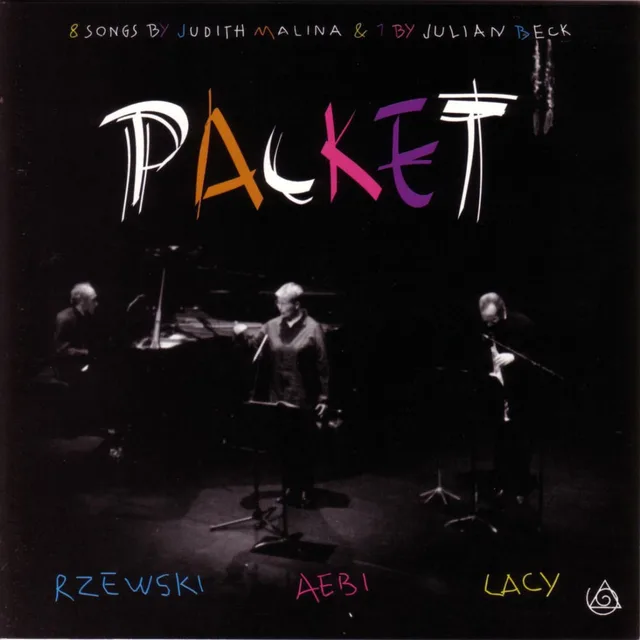
Steve Lacy - Packet
Steve Lacy doesn't compose to fill a void; he carves an opening where only the trio's breath is heard. Packet, released in 1995 on New Albion Records, isn't an attempt to return to roots but rather a sonic architecture built around a rare trinity: soprano saxophone, piano, and voice. This album presents itself as a manifesto of concentration where each track lasts about six minutes, revealing the compositional economy of the group assembled by the label specializing in contemporary music.
Steve Lacy, Frédéric Rzewski, and Irène Aebi: an instrumental trinity serving avant-garde jazz
The album anchors itself in a specific context: a trio recording produced on New Albion Records, a label known for its contemporary music productions.
Theatre: the inaugural track establishing the codes of interaction between soprano, piano, and voice
The album opens with Theatre, the first track on the tracklist. This opening piece isn't just an introduction; it immediately defines the rules of engagement for the trio. Steve Lacy's saxophone doesn't seek to impose a dominant melodic line but rather to dialogue with Rzewski's piano, while Irène Aebi's voice traverses the sonic space without ever seeking to overpower it.
First And Last Pain: textural density where vocal clarity meets free improvisation
Halfway through the journey, First And Last Pain embodies the very heart of the album. The presence of these poetic lyrics does not weigh down the record but rather enriches its emotional palette.
Do Not Judge Me Lightly #2: the conclusion to a 58-minute journey where each track lasts about six minutes
The record closes with Do Not Judge Me Lightly #2, the tenth and final track. This concluding piece is not merely an epilogue but a resonance of the initial choices made by Theatre. The two-part structure (the #1 and the #2) already suggests in its title a reflection on repetition and variation, central themes of the album. Steve Lacy plays with textural density that reaches its peak, while Frédéric Rzewski orchestrates a resolution where piano and saxophone seem to merge into a single surge. The total duration of 58 minutes for ten tracks gives each moment its full importance: not too long to bore, nor too short to be superficial.
A Concentrated Work Summary
This is not a step backward toward the instrumental solos of the 1960s, but an advance toward a collective architecture where soprano, piano, and vocals form an inseparable whole. Between Spirit of Mingus (1992) and Communiqué (1997), this record positions itself as a watershed moment in Steve Lacy's trajectory, confirming his ability to explore new sonic territories without ever abandoning his own voice.
Technical Details
- Release: 1995 - Label: New Albion Records - Tracks: 10 (58 min 21 s) - Opening / Closing: Theatre / Do Not Judge Me Lightly #2
🎬 The album's music videos
10 clips · continuous playback
Tracks
- 1
- 2
- 3
- 4
- 5
- 6
- 7
- 8
- 9
- 10
🔥 The tracks that are blowing up
Hip-Hop/R&B ranking · week of 12/10/2026
- 1Solar Eclipse— Drake & Don Toliver
- 2Quebec— Drake
- 3I Just Might— Bruno Mars
- 4Cold Shoulder— Drake, Don Toliver & Yebba
- 5Janice STFU— Drake
- 6Dead Fresh— Lil Baby
- 7Classic— Drake
- 8What You Need— Tems
- 9Cinderella— Mac Miller Featuring Ty Dolla $ign
- 10So Good— Jhene Aiko Featuring Kendrick Lamar


