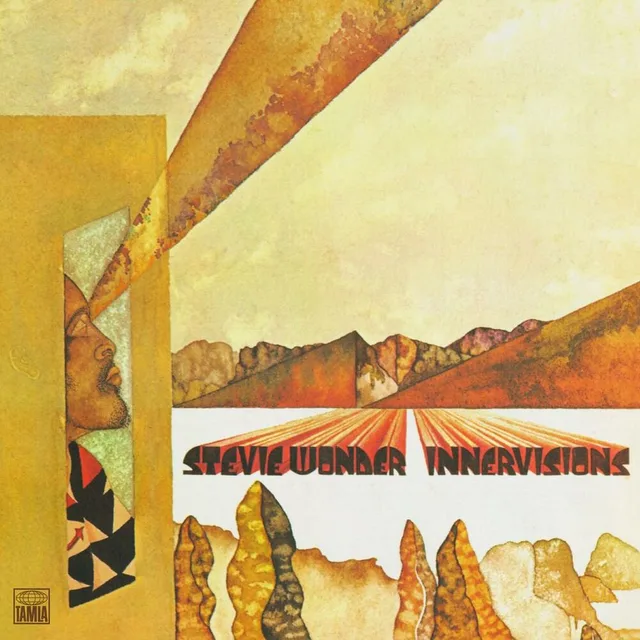
Stevie Wonder - Innervisions
Innervisions is the name Stevie Wonder gives to this sonic architecture built without an external architect. The album is a monument of independence, a building where every brick—whether instrumental or textual—was laid by his creator's own hand alone. Released on August 3, 1973, on Tamla, it stands as a clear separation between the prodigious youth of Talking Book and the experience that would follow with Fulfillingness' First Finale. Here, there is no attempt to please a broad audience by playing the game of pop variety; rather, it serves to set forth an observation, to write an urban chronicle where every track is a statement. The album features nine tracks produced entirely by Wonder himself, which means that creative autonomy is not merely claimed in the lyrics but embodied in the very substance of the sound.
Too High: A Condemnation of Urban Excesses
It's an invitation to refusal, a warning against a world that burns right inside the very studios where it is recorded. The track functions as an inverted prophecy: where heat should be a metaphor for love, Wonder sees it as a sign of social decay. The album's opening isn't just a simple prelude; it's a declaration of war on ambient indifference. The polished production doesn't serve to embellish but rather crystallizes the message. Every instrument plays its part with surgical precision that reinforces the violence of the social critique. Wonder needs no featuring to carry this discourse; his voice alone is enough to transform a mere opening track into a political manifesto.
Living For The City: a social portrait of a city that never sleeps
If Track 1 denounces individual excesses, this one offers a complete panorama of collective struggles. It's here that the album achieves its most frank mutation toward militant engagement: Wonder no longer just writes about the world; he observes it with almost anthropological lucidity. The city becomes the main character in the story, and the tracks that follow will prolong this exploration without ever straying from the fieldwork.
Golden Lady: the apotheosis of militant lyricism
Track 4, Golden Lady, offers a different perspective without ever abandoning the political dimension. While previous tracks showed the city in action, here it is the female figure who embodies social heroism. The track isn't just a simple compliment of love; it's a public acknowledgment of a moral force that cuts through all layers of society. Wonder uses this metaphor to show how individual resistance can become collective. The sunny melody of the track contrasts intentionally with the hardness of previous lyrics, but this contrast serves only to reinforce the message: hope is not a weakness, it's a political weapon. It is in this track where the album finds its greatest synthesis between engagement and pop aesthetics.
Higher Ground: the spiritual and political manifesto
Track 5, Higher Ground, functions as an anthem that crowns the series of engaged tracks. Wonder transforms a simple melody into a universal proclamation where spirit becomes the only legitimate territory. The track doesn't just talk about personal spirituality; it elevates this faith into a political principle, pitting moral values against a system that betrays them. This is the moment where the album transcends simple social critique to reach an almost prophetic dimension. The polished production of the record serves here to give monumental resonance to this message: every instrument participates in the invisible choir of the song.
Summary: between soul, funk, and militant activism
Innervisions stands as the central pivot of a career where Stevie Wonder ceases to be the child prodigy to become a complete artist. There is no featuring here to complement his sonic universe; each song is an autonomous construction signed by the hand of the sole producer. The album confirms what Talking Book had started: Wonder's ability to transform his technical mastery into an uncompromising political language. It is an album where every song is a stance, a declaration of independence that has never been contradicted since.
Technical details
- Release: August 3, 1973 - Label: Tamla - Songs: 9 - Opening / Closing: Too High / He's Misstra Know-It-All
🎬 The album's music videos
9 clips · continuous playback
Tracks
- 1
- 2
- 3
- 4
- 5
- 6
- 7
- 8
- 9
🔥 The tracks that are blowing up
Hip-Hop/R&B ranking · week of 12/10/2026
- 1Solar Eclipse— Drake & Don Toliver
- 2Quebec— Drake
- 3I Just Might— Bruno Mars
- 4Cold Shoulder— Drake, Don Toliver & Yebba
- 5Janice STFU— Drake
- 6Dead Fresh— Lil Baby
- 7Classic— Drake
- 8What You Need— Tems
- 9Cinderella— Mac Miller Featuring Ty Dolla $ign
- 10So Good— Jhene Aiko Featuring Kendrick Lamar