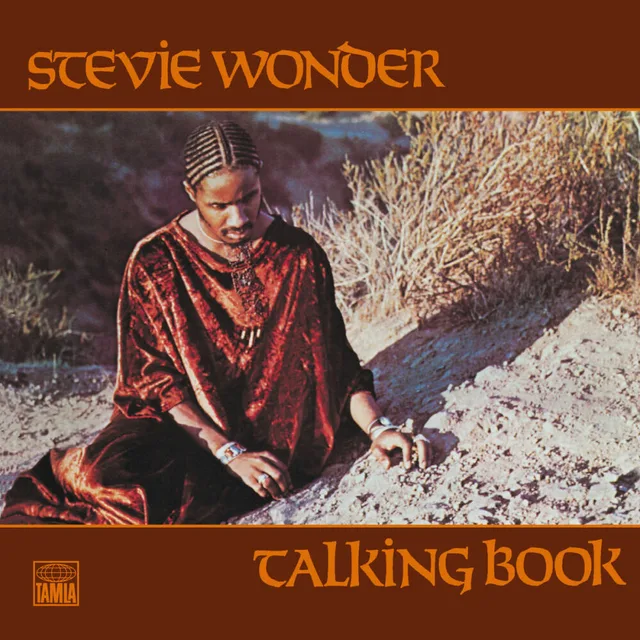
Stevie Wonder - Talking Book
"You Are the Sunshine of My Life" doesn't just open Talking Book; it sets its tone from the very first note. This album, released on October 27, 1972, by Tamla, is not merely a continuation of Music of My Mind (1972). It is a sharp break. Where its predecessor still played with the codes of a virtuous adolescent, Stevie Wonder erects his own architecture here. A work with human features, entirely carried on the sole hand of the composer.
You Are the Sunshine of My Life: The Genesis of a Solar Hymn
The opening is an assertion of presence. You do not need to know Stevie Wonder to understand that this track is a personal manifesto. It is the signature of an artist who no longer asks to be introduced. He stands already there, at the center of the sonic stage.
Superstition: A Demonstration of Total Instrumental Mastery
If the opening is solar, Superstition is a declaration of war against convention. It is not a collaborative track nor a co-production with an external recording engineer. Every rhythmic break, every piano slide, is the act of absolute sovereignty.
Blame It on the Sun: The Turn Toward Intimacy
After the raw power of Superstition, the album turns to colder introspection. Blame It on the Sun is not a love track, but an observation. It is no longer about celebrating, but accusing. It is the album that prepares for closure without ever betraying its initial promise.
I Believe (When I Fall in Love It Will Be Forever) : The Philosophical Closer
I Believe is not just a rallying song; it's a definition of an engagement for eternity. It closes the album on a note that leaves no room for doubt. Between this sunny opening and this philosophical closer, all the other tracks — from Maybe Your Baby to Lookin' for Another Pure Love, passing through Tuesday Heartbreak — serve only to build the slope between two poles.
Verdict: Absolute Autonomy as Strength
This album is not just a studio record; it's a manifesto. It marks the passage from young prodigy to complete man, without any technical or artistic flaw. The strength of Talking Book lies in its ability to transform every second of recording into an act of creative sovereignty. That is why it remains today an indispensable reference, not only for Stevie Wonder's discography but for all the history of pop music. Talking Book does not need to be long to be complete; ten tracks suffice when every second is an act of artistic sovereignty. It is a work born from creative solitude, where Stevie Wonder leans on no one. Between The Jazz Soul of Little Stevie (1962) and Innervisions (1973), this album marks the passage from young prodigy to complete man. There is no weakness here, only the strength of a creation that betrays no foreign voice.
Technical Specifications
- Release: October 27, 1972 - Label: Tamla - Tracks: 10 - Opening/Closing: "You Are the Sunshine of My Life" / "I Believe (When I Fall in Love It Will Be Forever)"
🎬 The album's music videos
10 clips · continuous playback
Tracks
- 1
- 2
- 3
- 4
- 5
- 6
- 7
- 8
- 9
- 10
🔥 The tracks that are blowing up
Hip-Hop/R&B ranking · week of 12/10/2026
- 1Solar Eclipse— Drake & Don Toliver
- 2Quebec— Drake
- 3I Just Might— Bruno Mars
- 4Cold Shoulder— Drake, Don Toliver & Yebba
- 5Janice STFU— Drake
- 6Dead Fresh— Lil Baby
- 7Classic— Drake
- 8What You Need— Tems
- 9Cinderella— Mac Miller Featuring Ty Dolla $ign
- 10So Good— Jhene Aiko Featuring Kendrick Lamar