
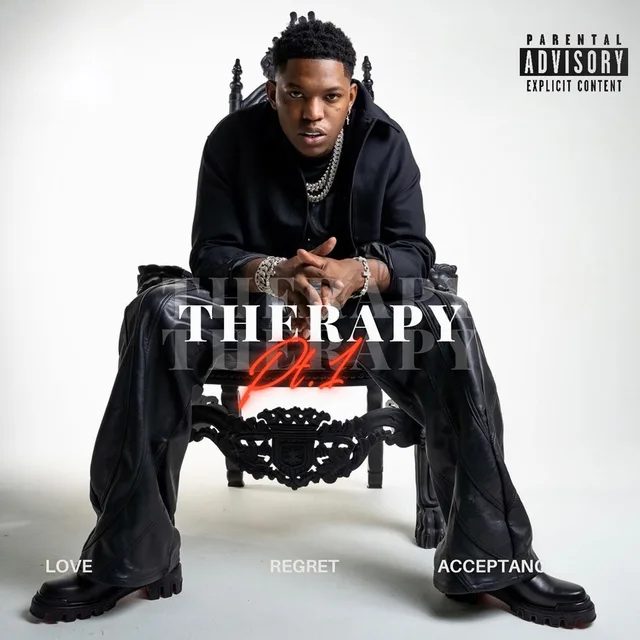
Yung Bleu's album THERAPY, released on January 9, 2026, on Moon Boy Music, is forty-nine minutes and sixteen seconds long, featuring fifteen tracks. Bridging the introspective nature of the previous album Bleuski (2025) and the expansive scope of the subsequent project World At War (2026), this album functions as a sonic bridge, oscillating between the solitude of the recording process and the sudden brilliance of collaborations.
Don't Judge Me: The Threshold of Solitary Therapy
The opening track, Don't Judge Me, immediately establishes the setting for a project where introspection takes precedence over collective performance. This track serves not only as an introduction, but also as the foundation for an internal exploration that will structure the entire album. As the first track, it defines the tone of pure introspection, far from the complex arrangements or multiple harmonies that will come later. It's an opening that invites careful listening, as if Yung Bleu is opening the doors to his studio, inviting the listener in without filter. The position number one on the tracklist is not arbitrary: it marks the beginning of a journey where each subsequent track will need to meet this demand for raw truth initiated from the very first second.
Can We Hook Up: The Injection of Multiple Voices into the Project
While most of the tracks remain the domain of a solitary voice, Can We Hook Up introduces a major thematic and sonic shift by incorporating Kim McCoy, Voiice, and Carvena. This collective presence on a single track fundamentally alters the album's dynamic: where the rest of the album relies on Yung Bleu's unique voice, this track becomes a space for dialogue, exchange, and shared resonance. The inclusion of these three voices is not simply a collection of names; it introduces a tension between the intimate and the communal, between the shadows of the studio and the light of collaboration. This is where the album reveals its ability to alternate between narrative solitude and the richness of a project open to other artists. The tracklist places this track away from the opening, but its impact is immediate: it proves that Yung Bleu knows when to break away from the solo format to explore a more collective dimension without compromising the integrity of the project.
15 tracks for 49 minutes 16 seconds: a rigorous narrative structure
The density of the fifteen tracks, totaling forty-nine minutes and sixteen seconds, suggests a precise balance between introspection and openness, without ever falling into either excess or emptiness. Each selection plays a specific role: Drunk Sex, in the second position, immediately establishes itself as an affirmation of direct themes that do not shy away from ambiguity, while titles like Nobody Like You or Sex In The Kitchen continue to contribute to this flow without ever breaking the overall coherence. The structure of the album does not prioritize either long tracks or short excerpts; rather, it seeks a linear progression where each piece contributes to the balance between light and shadow, between solo and collaboration. This architectural rigor is reflected in the numbering of the tracklist: each position has its importance, and no transition is left to chance.
Highlights: the end of a cycle between introspection and collective resonance
The final track, Highlights, concludes the album by synthesizing the two opposing forces that drove the project: the introspective solitude of the early tracks and the collective resonance of the song with Kim McCoy, Voiice, and Carvena. This closing track doesn't just provide a summary; it encapsulates the balance found between the studio's shadows and the light of collaboration. As the final song, it offers a unified perspective on the journey undertaken since Don't Judge Me, demonstrating how Yung Bleu managed to maintain a cohesive narrative despite the variations in format. The fifteenth track on the tracklist is not just an ending; it is the culmination of an exploration that has successfully alternated between the intimate and the collective, between solitude and connection.
Review: A two-speed album
THERAPY stands out for its ability to navigate between two registers without ever sacrificing one for the other. The album does not aim for uniformity; it embraces contrasts, as demonstrated by the coexistence of a solitary and collaborative approach within the project. With fifteen tracks totaling forty-nine minutes and sixteen seconds, Yung Bleu offers a carefully balanced composition, where each track has its place within this rigorous narrative structure. Between Bleuski and World At War, this album positions itself as a transitional work, where the solitude of writing sometimes gives way to the richness of multiple voices, without ever losing its identity.
Technical Details
- Release Date : January 9, 2026 - Label : Moon Boy Music - Tracks : 15 (49 min 16 s) - Opening / Closing : Don't Judge Me / Highlights - Guest Artists : Kim McCoy, Voiice, Carvena - Previous Album : Bleuski (2025)
🎬 The album's music videos
14 clips · continuous playback
Tracks
- 1
- 2
- 3
- 4
- 5
- 6
- 7
- 8
- 9
- 10
- 11
- 12
- 13Shakirafeat. Sevyn Streeter
- 14
- 15
- 16
🔥 The tracks that are blowing up
Hip-Hop/R&B ranking · week of 12/10/2026
- 1Solar Eclipse— Drake & Don Toliver
- 2Quebec— Drake
- 3I Just Might— Bruno Mars
- 4Cold Shoulder— Drake, Don Toliver & Yebba
- 5Janice STFU— Drake
- 6Dead Fresh— Lil Baby
- 7Classic— Drake
- 8What You Need— Tems
- 9Cinderella— Mac Miller Featuring Ty Dolla $ign
- 10So Good— Jhene Aiko Featuring Kendrick Lamar


