
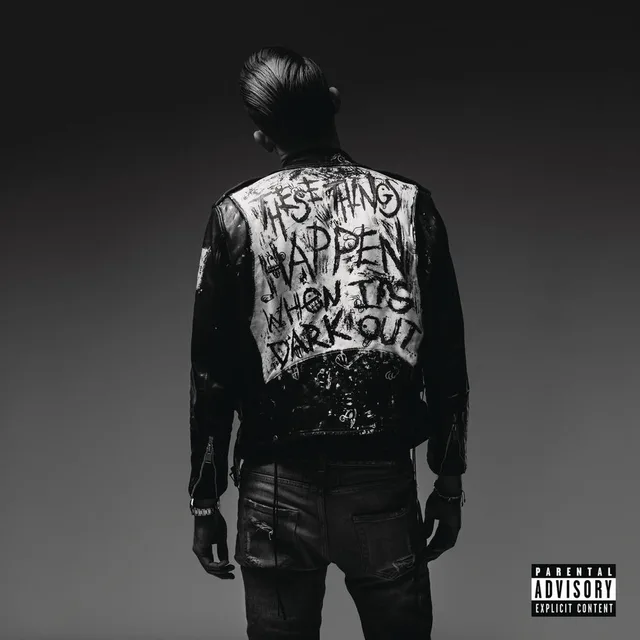
G-Eazy - When It’s Dark Out
The Aesthetic of the Nightmare: Hazy Piano and Synths
G-Eazy constructed When It's Dark Out as the soundtrack to a horror film. It is an audacious gamble, with the artist citing Wes Craven and Tim Burton as direct influences during recording sessions between 2014 and 2015. The goal was clear: create a dark, cinematic, and oppressive atmosphere. Released on December 4, 2015, by RCA Records, this fourth studio album departs from the traditional codes of commercial rap to embrace a more narrative and visual aesthetic. Executive production is handled by G-Eazy himself, alongside his usual collaborator Christoph Andersson and producer Southside. This trio lays the groundwork for a consistent sonic universe before other producers arrive. On track 2, Random, OZ signs off on a production that fits this logic of melodic tension. Further down the album, track 6, Of All Things, benefits from Boi-1da's work, whose rhythmic touch provides necessary contrast to the whole. Finally, Southside returns for tracks 10 and 11, You Got Me and What If, to anchor the album in a more direct dynamic. This mosaic of producers, limited here to the four names explicitly cited in the credits (OZ, DJ Spinz, Boi-1da, Southside), allows one to avoid dispersion while maintaining the unity of the project.
The Clash of Timbres: When R&B Dilutes the Horror
If the initial intent was to sound like a thriller, the sonic reality soon runs up against market demands. The album features 17 tracks for a total runtime of one hour and one minute, with twelve of those tracks including guest appearances. This collaborative density creates immediate friction between the dark aesthetic desired by G-Eazy and the R&B and pop trends dominating the music scene in 2015. This duality is at the heart of the problem. On one hand, the desire to create an unsettling atmosphere; on the other, the necessity of integrating melodic voices capable of reaching a broad audience. The result is an album where timbres sometimes clash. Track 13, Some Kind Of Drug, serves as a striking example: Marc E. Bassy brings vocal energy that contrasts with the sobriety of previous productions. This isn't inherently a flaw, but it's symptomatic of a difficult search for balance to maintain across all 17 tracks.
Bebe Rexha, Chris Brown, and the Melodic Divide
The features are at the heart of this tension. On Me, Myself & I (track 3), Bebe Rexha brings a clear and bright voice that contrasts with the overall atmosphere of the album. This collaboration perfectly illustrates G-Eazy's strategy: using powerful female voices to broaden his audience reach. Michael Keenan Leary's production on this track serves as a bridge between rap and pop, reinforcing the crossover aspect noted by critics. Further along, Drifting (track 5) reunites Chris Brown and Tory Lanez for a male vocal duo that strengthens the melodic side of the song. The production by Cashmere Cat, Happy Perez, and MssingNo adds an electronic dimension that moves away from the initial piano loops. This track shows how G-Eazy attempts to integrate urban pop codes without losing his identity. Finally, track 17, Nothing to Me, closes the album with Keyshia Cole and E-40. The pairing of two distinct universes (R&B and rap) on the final song symbolizes G-Eazy's desire to cover all bases, even at the risk of diluting his own voice.
Sonic consistency against narrative dispersion
The album opens with Intro (track 1) and closes with Nothing to Me (track 17), a structure that frames the narrative arc of the record. However, critics have pointed out a certain dispersion in the second half of the recording. Ben Thompson of The Guardian estimates that the album "could have been perfect if it hadn't tried to cover all bases", specifically criticizing the latter part of the record. This observation aligns with Billboard's take on R&B attempts deemed generic. Sheldon Pearce of Pitchfork Media sees this album as an improvement over These Things Happen (2014), noting that the production and features seem to be "a conscious effort by G-Eazy to add more dynamism to his sound and make it less monotonous". This progression is real, even if uneven.
Commercial platinum with divided critical reception
Commercially, When It's Dark Out achieved significant success. The album debuted at number five on the Billboard 200 in the United States with 135,000 copies sold in its first week. Even more impressive, it reached number one on the US Top R&B/Hip-Hop Albums chart. This performance confirms G-Eazy's appeal to the American hip-hop and R&B audience. The Platinum certification from the Recording Industry Association of America (RIAA) in July 2016 validated this commercial success. However, critical reception remains nuanced. While most reviews are positive, reservations about artistic consistency persist. The album manages to strike a balance between cinematic ambition and commercial demands, but at the cost of certain sonic fragmentation. Ultimately, When It's Dark Out is a transition record for G-Eazy. The album demonstrates the artist's ability to navigate between different sonic universes, even if this versatility sometimes leads to contradictions. It is a recording that prioritizes immediate impact over long-term artistic longevity—a strategy that paid off commercially but left its mark on critical reception.
Technical Specifications
- Release: December 4, 2015 - Record label: RCA - Tracks: 17 (1:01 min) - Opening / Closing: Intro / Nothing to Me - Guests: Bebe Rexha, Big Sean, Chris Brown, Tory Lanez, Too $hort, Starrah, SAYGRACE, Gizzle, Marc E. Bassy, QUIN, Kehlani, IAMNOBODI … - Previous album: These Things Happen (2014)
🎬 The album's music videos
17 clips · continuous playback
Tracks
- 1
- 2
- 3Me, Myself & Ifeat. Bebe Rexha
- 4One of Themfeat. Big Sean
- 5Driftingfeat. Chris Brown, Tory Lanez
- 6
- 7Order Morefeat. Starrah
- 8
- 9
- 10
- 11
- 12
- 13
- 14
- 15
- 16
- 17Nothing to Mefeat. E-40, Keyshia Cole
🔥 The tracks that are blowing up
Hip-Hop/R&B ranking · week of 12/10/2026
- 1Solar Eclipse— Drake & Don Toliver
- 2Quebec— Drake
- 3I Just Might— Bruno Mars
- 4Cold Shoulder— Drake, Don Toliver & Yebba
- 5Janice STFU— Drake
- 6Dead Fresh— Lil Baby
- 7Classic— Drake
- 8What You Need— Tems
- 9Cinderella— Mac Miller Featuring Ty Dolla $ign
- 10So Good— Jhene Aiko Featuring Kendrick Lamar


