
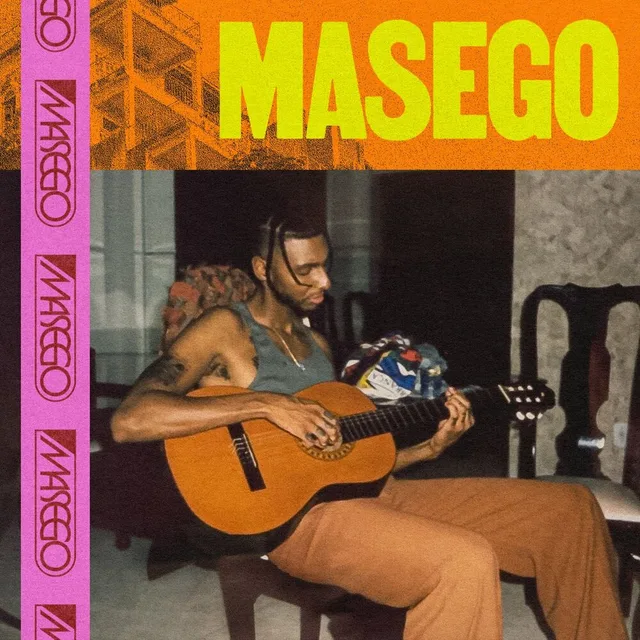
Micah Davis is leaving behind the vibrant energy of his debut album, Lady (2018), to embark on a path of complete isolation with his self-titled studio album, released on March 3, 2023. This second full-length album does not seek to multiply surface effects or rely on external figures to convey its message; instead, it opts for a sound architecture built entirely around introspection. Distributed by EQT Recordings and Capitol Records, this 14-track album functions as a manifesto of pure creativity: abandoning any commercial strategy based on collaborations, it focuses on the stylistic coherence of a genre defined as TrapHouseJazz.
The manifesto of absence: 14 tracks without credited features
The album Masego immediately stands out due to a deliberate constraint that resonates in every line: the complete absence of featured artists on established platforms. This absence is not compensated by the presence of well-known names, but rather by a deliberate architectural choice where Micah Davis's voice becomes the primary means of expression. The 14 tracks that make up the album, listed exactly in the order of the tracklist – from Black Anime to Eternal Sunshine (Fire Pit) – form a seamless, uninterrupted flow. Far from the collaborative norm of modern rap, this project imposes an intimate listening experience, where the artist navigates alone through his personal themes. It's a return to the basics, where the lyrical complexity must be sufficient to fill the sonic space without external assistance.
TrapHouseJazz: when funk and trap fuse together
At the heart of this radical introspection, the production serves as the fundamental pillar that maintains the unity of the album. Far from being an acoustic album or a collection of stripped-down ballads, Masego is built on a distinctive sound that is marked by influences from funk and jazz-soul, which are central to its essence. The precise description of the style identifies a fusion of trap and house beats, creating a sound that is both cool and breezy, and which grounds the project in the codes of neo-soul and contemporary R&B. This TrapHouseJazz signature is not simply an aesthetic label, but a working method in which the artist adopts an informal approach to get to the core of the matter. The album does not seek to imitate other productions, but rather to embody this identity, where jazz and funk are at the heart of Micah Davis's musical approach.
The bare cover: an informal provocation
The visual aesthetic of the album reinforces this desire for radical simplicity, with a cover featuring an informal photograph without a title or featured artist. This understated image contrasts with the expectations of listeners accustomed to visually saturated imagery or collaborations announced by the presence of names on the cover. As if Masego wanted to focus on the essentials in this second full-length project, the album rejects any visual or commercial emphasis. The absence of a title and images invites listeners to focus exclusively on the sonic content rather than the appearance. This visual simplicity perfectly aligns with the 14 unique tracks that frame the album, with precise opening and closing pieces, thus validating a solitary vision where each element counts without unnecessary embellishment. The cover becomes a conscious artistic choice that obscures the richness of the sound for those who only see the surface, encouraging a more attentive listening experience.
Emotional maturity in a major second act
This sonic architecture is rooted in the biography of Micah Davis, whose Jamaican and African heritage permeates every note of the album. His father was a military officer in the U.S. Air Force, and his mother, an entrepreneur, raised their son in a non-denominational Christian household before military deployments moved the family to Virginia. It was in this transatlantic environment that he attended Old Dominion University in Norfolk before dedicating himself fully to a musical career. From a young age, the drums became the first instrument he learned, without formal lessons, while mastery of the piano, saxophone, and various rhythm boxes completed his technical skillset. It was in high school that he adopted the name Masego after discovering that his family had roots in South Africa, a pervasive cultural heritage that translates into an artistic identity where funk and jazz-soul form the immutable foundation of his expression. The self-titled studio album Masego thus reveals itself to be Masego's second major work, released in 2023 before his next full-length album, Fix Your Face, expected in 2026. This 14-track album marks a deliberate departure from the vibrant world he had previously created through singles, mixtapes, and EPs bursting with audacity. This informal approach, illustrated by a cover featuring a simple photograph without a title or featured artists, validates his desire to focus on the essentials in this second full-length album. Far from being an acoustic album, this work embodies a working method where Micah Davis's solo vocals become the primary instrument, navigating through his personal themes to prove that music remains at the center of his concerns, away from external turmoil and the commercial expectations imposed by the industry. This project marks a crucial step in the artist's trajectory, situated between Lady (2018) and his next opus, Fix Your Face (2026). In this interval, Masego embraces his musical and emotional maturity, transforming an album that was still full of youthful energy into a more coherent and complete work. The album explores the unfulfilled aspects of his life and proves that music remains at the center of his concerns, away from external turmoil. This evolution is visible in the way the artist adopts a mature, self-aware posture while remaining connected to his Jamaican and African roots. The closing of the album with Eternal Sunshine (Fire Pit) seals this introspection, while the opening with Black Anime sets the tone for reflection that lasts until the end.
Technical specifications
- Release date: March 3, 2023 - Label: EQT Recordings/Capitol Records - Number of tracks: 14 - Opening/closing: Black Anime / Eternal Sunshine (Fire Pit) - Previous album: Lady Lady (2018)
🎬 The album's music videos
14 clips · continuous playback
Tracks
- 1
- 2
- 3
- 4
- 5
- 6
- 7
- 8
- 9
- 10
- 11
- 12
- 13
- 14
🔥 The tracks that are blowing up
Hip-Hop/R&B ranking · week of 19/10/2026
- 1I Just Might— Bruno Mars
- 2Solar Eclipse— Drake & Don Toliver
- 3Janice STFU— Drake
- 4Quebec— Drake
- 5Dead Fresh— Lil Baby
- 6What You Need— Tems
- 7Cold Shoulder— Drake, Don Toliver & Yebba
- 8So Good— Jhene Aiko Featuring Kendrick Lamar
- 9WTF GOIN— Belly Gang Kushington & 21 Savage
- 10Cinderella— Mac Miller Featuring Ty Dolla $ign